Sportsbook Data Feeds: From Source to Market
How sports data moves from source systems into trading, pricing and customer-facing betting markets.
Sportsbook data is a chain of evidence
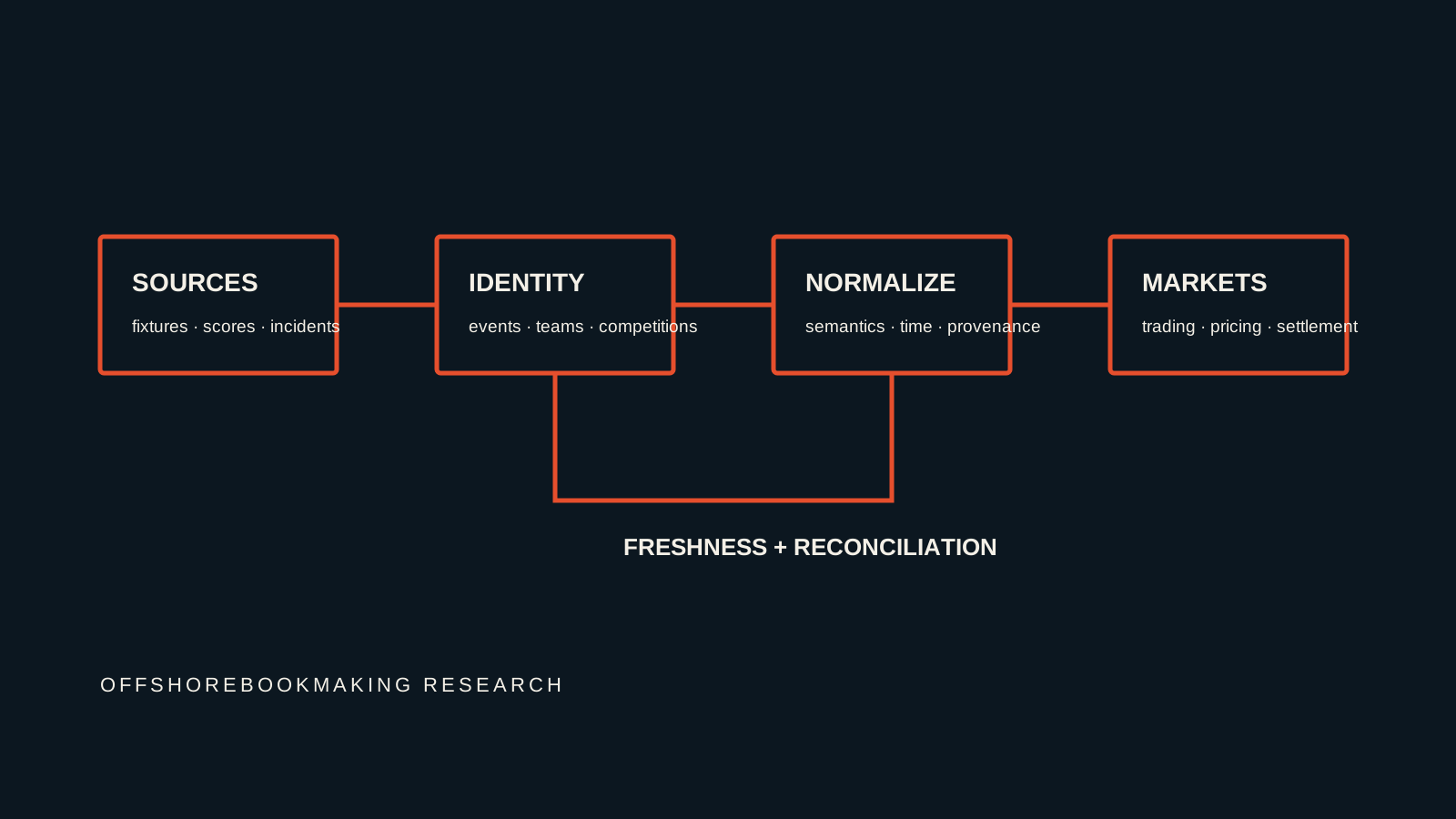
Sportsbook data is often described as a feed, but the useful mental model is a chain of evidence. Information begins with a source, passes through collection and distribution systems, is normalized into an operator's internal model and eventually influences a market shown to a customer. At every stage, the meaning of the data can change. A fixture may be created before a venue is confirmed, a participant name may differ between suppliers, and an in-play incident may later be corrected. The operator therefore needs more than a value; it needs context about where that value came from, when it was observed and whether it supersedes an earlier observation. This is the connection between the Data and Technology desks. Technology provides the transport and storage layers, while data design determines whether those layers preserve enough evidence for trading, settlement and later investigation. A reliable architecture treats provenance, timestamps and identity as first-class information rather than optional metadata.
Not every sports data source plays the same role
A sportsbook can consume schedules, rosters, scores, statistics, play-by-play incidents, official results, trading inputs and market prices from different sources. Some information originates with leagues or governing bodies, some with venue-based collection networks, and some with specialist commercial suppliers. Operators may also generate proprietary observations or trading adjustments internally. These sources should not automatically be treated as interchangeable. An official result source may be authoritative for settlement while a lower-latency source is preferred for live market management. A schedule provider may be excellent for broad coverage yet weaker for late venue changes in a specific competition. The important architectural decision is to define the role of each source. That includes what the source is allowed to update, how quickly it is expected to update, what fallback exists and which record wins when two inputs conflict. Provider research becomes much more useful when these responsibilities are explicit instead of reducing comparison to the number of sports or events advertised.
Canonical identity is the foundation of reconciliation
Data from different suppliers rarely arrives with a universal identifier for the same real-world event. One provider may identify a team, competition or fixture with its own numeric key while another uses a completely unrelated code. Names are not safe substitutes because abbreviations, sponsorship names, translations and spelling conventions change. A robust sportsbook therefore maintains canonical internal identities and maps supplier records onto them. Event matching normally considers sport, competition, participants, scheduled time and other evidence rather than one display string. The mapping also needs a controlled unresolved state when evidence is insufficient; forcing a match can contaminate prices, scores and settlement. Once a canonical relationship is established, downstream systems should consume that stable identity instead of repeatedly guessing. This principle supports internal linking between Data, Technology and future Provider research because it separates the operator's durable model from the commercial supplier currently feeding it. Provider replacement then becomes a mapping problem rather than a complete rewrite of historical identity.
Timestamps describe different moments and must not be collapsed
A single timestamp cannot explain the lifecycle of a sports observation. The underlying event may have an effective time, the supplier may observe or publish it later, the operator may receive it after network delay, and an internal service may record or process it later still. Collapsing these moments into one field makes latency analysis and incident reconstruction unreliable. A mature data model distinguishes when something happened from when it was observed and when the platform learned about it. That distinction is particularly important for live betting. If a goal occurred at one moment but reached the trading system several seconds later, engineers need to measure the path rather than merely know the final database insertion time. The same model helps with corrections: a provider can publish a new observation that refers to an earlier effective moment without overwriting the historical fact that the first version was received. Preserving these timestamps turns a feed into an auditable sequence and gives Operations evidence for supplier and incident reviews.
Normalization makes multiple feeds usable together
Raw provider schemas reflect the supplier's own product decisions. Sports may be named differently, market types may use different codes, participants may be ordered differently and status values may carry subtly different meanings. Normalization translates those external representations into a stable internal vocabulary. The goal is not to erase useful source detail but to prevent every downstream consumer from implementing provider-specific logic. A canonical model might define common concepts for event status, participant role, period, market, outcome and price while retaining the original payload or source reference for audit. Good normalization also avoids false equivalence. Two markets with similar labels are not necessarily the same if their settlement rules differ. The mapping layer must therefore encode semantics, not simply rename fields. This work is less visible than a customer interface, but it determines whether trading, reporting and analytics can safely combine information. It also reduces migration cost when an operator adds a second feed or replaces an existing supplier.
Freshness and latency are business properties
Fast data is valuable only when the system can explain how fresh it is. Latency should be measured across the full path from source observation to customer-facing use, not only the response time of an API request. Different products also require different thresholds. Prematch schedules can remain useful with modest delay, while live incidents and rapidly moving prices may become unsafe within seconds. Operators should define freshness budgets by data class and decide what happens when those budgets are exceeded. A market might be suspended, a secondary source might be consulted, or a non-transactional display might continue with a visible timestamp. Silent staleness is the dangerous case because the interface appears healthy while the information has stopped advancing. Monitoring should therefore track the age of the newest valid observation, sequence gaps and source continuity. These metrics connect directly to the reliability practices described in Technology and to the operating procedures that will be examined in the Operations desk.
Redundancy requires reconciliation, not just a second supplier
Adding another data provider does not automatically create resilience. Two feeds can disagree, arrive at different speeds or represent the same event differently. Without a reconciliation policy, redundancy can create ambiguity precisely when the primary source is failing. Operators need rules for source priority, confidence, failover and return to normal operation. Some data classes may support automatic substitution; others may require manual confirmation because the commercial consequence of a wrong value is too high. A secondary source also needs continuous validation before an incident occurs. A feed that has not been mapped, monitored and compared under normal conditions is not a dependable emergency fallback. The architecture should record which source supplied the value actually used by trading or settlement so later reviews can reconstruct the decision. Provider diversity can reduce concentration risk, but only when canonical identity, semantic normalization and operational procedures allow the sources to be compared consistently.
Market data is different from event data
Sportsbooks also consume and produce market data: lines, prices, limits, availability and movement across selections and periods. This information has its own identity problems. A moneyline, spread or total must be tied to the correct event, period, participant or threshold and to the settlement rules under which it was quoted. Comparing prices from different sources without aligning those dimensions can produce misleading conclusions. The same applies to historical movement. A useful observation records the normalized value, source, effective or observed time and the context that defines the market. Last-traded or last-seen values should not silently replace a complete history when research depends on sequence. These principles matter for operator trading systems and for independent market analysis. They also show why a sportsbook data layer cannot be reduced to scores and fixtures. Event identity and market identity must meet cleanly before prices can be compared, monitored or presented as evidence.
Data quality needs explicit controls and measurable exceptions
Quality control should be designed as a set of testable rules rather than a general expectation that feeds are accurate. Systems can check required fields, impossible scores, duplicate events, unexpected time changes, stale sequences, missing participants and market values outside defined ranges. Some exceptions can be rejected automatically; others should be quarantined for review. The important point is to avoid converting uncertainty into apparently authoritative data. An unresolved mapping, missing timestamp or conflicting result should retain that status until evidence supports a transition. Dashboards can then measure the volume and age of unresolved exceptions, giving teams a practical view of data health. Historical quality metrics are also useful when evaluating suppliers because they reveal how often manual intervention was needed. This evidence complements contractual uptime numbers, which may say little about semantic correctness. A feed can be technically available while continuously delivering records that the operator cannot safely use.
A practical framework for evaluating sportsbook data providers
Evaluation should begin with the operator's actual data contract. Define the sports, competitions, data classes, latency needs, historical depth, redistribution rights and authoritative uses required by the product. Then examine a provider against that contract. Coverage claims should be tested at event and field level, not accepted as headline counts. Documentation should explain identifiers, update behavior, corrections, timestamps, rate limits and versioning. Technical trials should measure continuity and semantic quality over time, including quiet periods and busy live windows. Commercial review should clarify licensing, derived-data rights, retention and what happens to historical access after termination. Finally, the operator should map exit cost: how much internal identity, code and history depends on provider-specific structures? OffshoreBookmaking will use this framework as the Data desk expands into individual feeds, pricing sources and integrity services. The objective is not to name a universal provider, but to make the evidence required for a responsible comparison visible and repeatable.