The Sportsbook Industry Value Chain: Who Makes Money and Where
How operators, platforms, data and trading suppliers, payments, affiliates and other B2B services divide value, cost and strategic control.
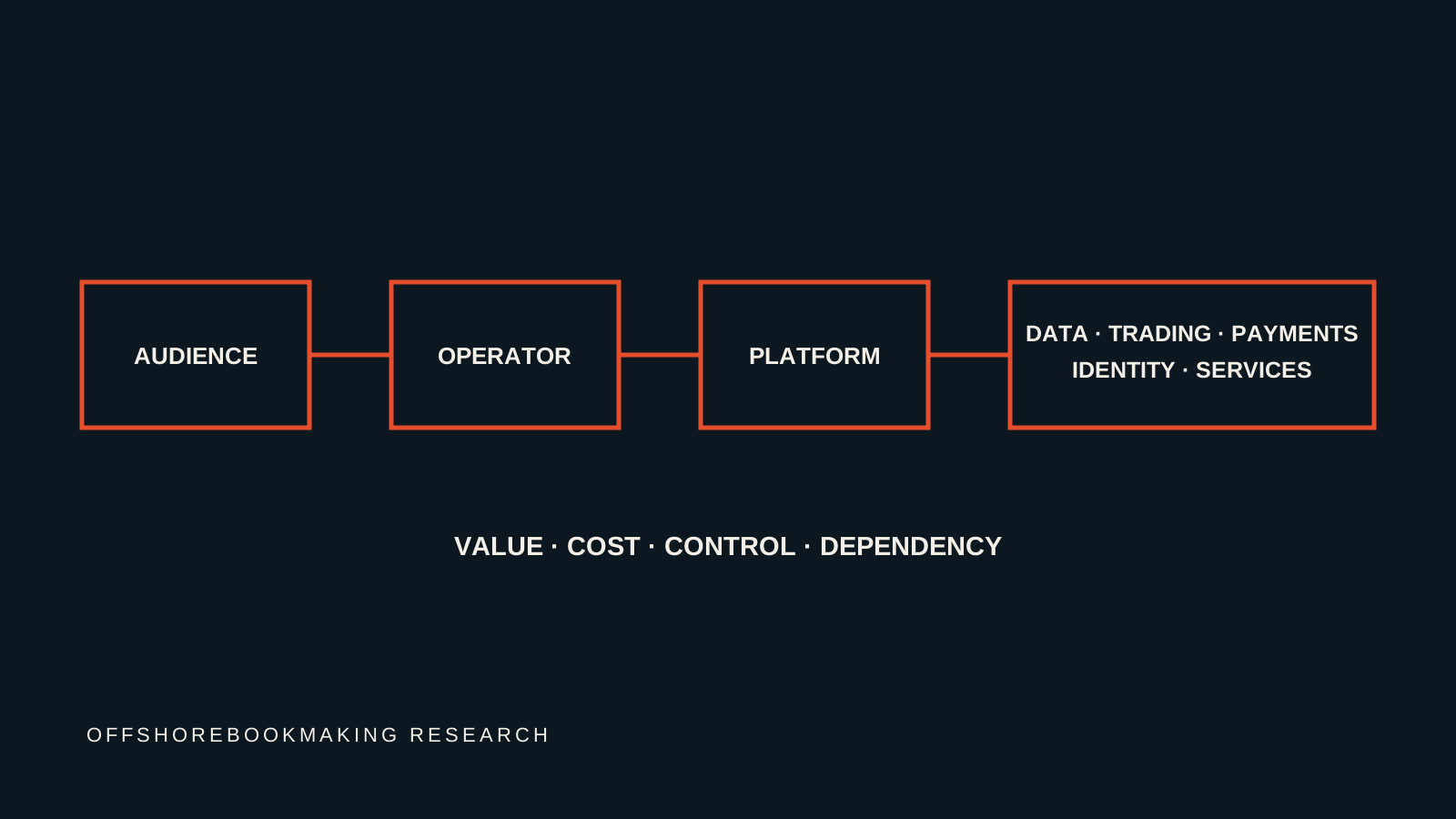
A sportsbook is assembled from an economic stack
The sportsbook industry is easier to understand when the operator is separated from the infrastructure underneath it. A consumer may see one brand, one balance and one betting interface, yet the product can depend on platform software, sports data, trading, payments, identity services, hosting, customer support tools, affiliate distribution and specialist risk systems supplied by different companies. Each layer has its own economics. Some vendors charge fixed fees, others price by account, transaction, data volume, revenue share or a combination. The operator sits at the point where those costs meet customer revenue and operational risk. OffshoreBookmaking therefore analyzes the industry as a value chain rather than a list of brands. Understanding who supplies which function reveals where bargaining power, dependency, margin and operational control actually reside.
Operators own the customer proposition but not necessarily every component
An operator generally controls the consumer-facing proposition: brand, market positioning, customer acquisition, promotions, service policies and the commercial decision about where and how to operate. That does not mean it built the underlying sportsbook. A brand can license a platform, outsource trading, buy official or aggregated sports data and integrate external payment methods. Another operator may internalize several of those capabilities. The distinction matters because two sportsbooks that look similar to customers can have radically different cost structures and technology ownership. Vertical integration can increase control but also increases fixed cost and organizational complexity. Outsourcing can accelerate launch and broaden capabilities while creating supplier dependence. Industry analysis should therefore ask not only who the operator is, but which parts of the stack it owns, controls contractually or receives as a managed service.
Platform providers sit close to the center of switching cost
The core sportsbook platform often connects accounts, wallets, markets, wagers, rules, reporting and external integrations. Because so many systems touch it, replacing the platform can be much harder than replacing a peripheral service. Data models must migrate, APIs must be reconnected, customer states preserved, payment paths retested and operational teams retrained. This creates switching cost even when a contract contains a formal termination right. A provider's economic power can therefore come from technical embeddedness as much as from product quality. Operators evaluating platforms should consider portability before launch: data export, canonical identifiers, integration ownership, custom-code boundaries and transition assistance. The Providers desk treats those issues as due diligence; from an Industry perspective they explain why long supplier relationships can persist and why platform consolidation can influence a wider network of operators.
Sports data and trading convert events into a sellable market catalogue
Sportsbooks need more than schedules and scores. They need event identity, market definitions, prices, status changes and result evidence, while trading functions decide what markets to offer, at what price and under what limits or risk rules. These capabilities can be internal, external or hybrid. Data suppliers may specialize in collection and distribution, while trading suppliers can provide odds creation, risk tools or managed services. The economics depend on coverage, latency, rights, reliability, market depth and service scope. A supplier with broad sport coverage may reduce integration count; a specialist may offer stronger depth in a particular market. Data #001 and #002 explain how raw feeds become normalized market observations. At industry level, those technical choices become procurement decisions and recurring costs that directly shape the operator's product breadth and resilience.
Payments are both infrastructure and a conversion constraint
Deposits and withdrawals connect sportsbook economics to banking and payment networks. Operators may integrate cards, bank transfers, wallets, vouchers, local payment methods or other supported rails depending on jurisdiction and customer base. Each route introduces fees, settlement timing, acceptance rates, fraud exposure, chargeback processes, currency considerations and operational support. A payment method that is inexpensive but frequently fails can damage conversion; a high-performing method can still be uneconomic if fees or fraud losses are excessive. Payment architecture also intersects with KYC, AML and customer-fund controls discussed in Regulation. Industry analysis should therefore avoid treating payments as a generic checkout feature. They are a network of commercial relationships whose availability can influence where an operator can serve customers and how much friction exists between acquisition, deposit, wagering and withdrawal.
Affiliates and media convert audience into distribution
Sportsbook customer acquisition frequently depends on external distribution. Affiliates, comparison sites, sports publishers, creators and other media businesses can send traffic or referred customers in exchange for commercial compensation where permitted. Models may include cost per acquisition, revenue share, fixed placements or hybrids. The economics create a separate layer between operator and customer: the operator pays for reach, while the publisher monetizes audience and intent. That relationship can be valuable but creates concentration risk when too much acquisition depends on a small number of channels. It also intersects with advertising and affiliate rules that vary by jurisdiction. From an information-architecture perspective, OffshoreBookmaking separates provider research from operator rankings or promotional claims. The goal is to understand distribution as an industry function: who controls audience, how referrals are measured and how commercial incentives influence the flow of customers.
B2B suppliers can serve competitors simultaneously
One unusual feature of the sportsbook value chain is that the same B2B supplier may power multiple competing consumer brands. A platform, feed, identity service or trading provider can spread development and infrastructure costs across many operators. That scale can make sophisticated capabilities accessible without each sportsbook rebuilding them independently. It can also reduce differentiation if many operators use similar catalogues, interfaces or risk services. Operators then differentiate through brand, market selection, pricing strategy, promotions, customer service, local knowledge or proprietary technology layered above shared infrastructure. Supplier scale can improve resilience and investment capacity, but concentration can create systemic dependency: an outage at one widely used vendor may affect numerous brands. Evaluating the industry therefore requires both operator-level competition and supplier-level concentration.
Revenue share changes incentives across the stack
Not every supplier is paid a simple software subscription. Revenue-share agreements can align vendor compensation with operator activity, but they also change marginal economics. A platform, trading service, affiliate or other commercial partner may receive a percentage defined against revenue or another contractual base. The exact definition matters because gross gaming revenue, net gaming revenue and adjusted contractual revenue are not interchangeable concepts. Deductions for bonuses, taxes, chargebacks, payment fees or other items can materially change the amount shared. Industry comparisons should therefore avoid quoting a revenue-share percentage without its denominator and exclusions. Revenue share can lower upfront cost and distribute risk, while fixed pricing can become more attractive at scale. The appropriate structure depends on volume, bargaining power, service scope and the operator's willingness to exchange margin for lower fixed commitments.
Unit economics connect acquisition, hold and operating cost
A sportsbook can generate substantial wagering volume without necessarily producing strong economic returns. Handle measures the amount wagered, while gross gaming revenue broadly reflects stakes retained after winnings under the definition being used. Hold expresses a relationship between those values, but it is not the operator's final margin. From gross revenue must come some combination of taxes where applicable, supplier fees, affiliate costs, payment costs, promotions, fraud losses, staffing, technology and other operating expenses. Customer acquisition cost and retention determine how much activity is produced by each marketing dollar. Because definitions vary among companies and jurisdictions, industry research should state the metric being discussed rather than treating handle, revenue and profit as synonyms. The economic stack matters precisely because every layer can claim part of the value generated by the customer relationship.
Scale can improve economics while increasing concentration risk
Larger operators and suppliers may spread fixed technology, compliance and operational costs across more customers and transactions. Volume can also improve negotiating leverage with vendors and distribution partners. These advantages help explain the strategic attraction of consolidation, partnerships and shared platforms. Yet scale does not eliminate execution risk. Integrating acquired systems can create duplicated platforms, fragmented customer identities and complex supplier contracts. A large supplier can become a critical dependency across many operators. A large operator can still be exposed to a small number of acquisition or payment channels. OffshoreBookmaking will therefore treat scale as an economic characteristic rather than an automatic measure of quality. The useful questions are where economies of scale arise, which costs remain variable, what dependencies become concentrated and whether the organization can preserve operational control as the stack grows.
Portability determines how much strategic freedom an operator retains
An operator's future options depend partly on whether it can move its data, integrations and workflows. Proprietary identifiers, undocumented APIs, supplier-owned customizations and restrictive export processes can make a nominally replaceable service difficult to leave. Portability has economic value because it affects negotiating leverage and the cost of changing strategy. A well-designed operator stack maintains canonical internal identities, documents integration contracts and knows which party owns custom code and derived data. It also plans for credential rotation, historical exports and transition periods. None of this means every component should be interchangeable; deep integration can create genuine efficiency. The point is to understand the trade. Provider lock-in is not merely a technical concern. It is a structural industry factor that can shape pricing, product roadmap and the operator's ability to respond when regulation, customer demand or supplier performance changes.
A practical framework for mapping the sportsbook value chain
OffshoreBookmaking will map the industry by following value and dependency from the customer backward through the stack. Start with the operator and its customer proposition. Identify the platform and wallet architecture, then the data and trading services that create the market catalogue. Map payment and identity infrastructure, distribution partners, compliance-sensitive services and supporting technology. For each relationship, record what is supplied, how it is priced, which data or systems it controls, what happens during failure and how difficult replacement would be. Then connect those dependencies to unit economics: acquisition cost, payment cost, supplier fees, revenue share and operational overhead. This framework links Industry with Technology, Data, Operations, Regulation and Providers. The result is a more useful picture than a directory of company names: it shows how the sportsbook economy is assembled, where value flows and where strategic dependency accumulates.