How to Evaluate Sportsbook Providers: A Due-Diligence Framework
A practical framework for comparing sportsbook platforms, data, trading, payments and specialist suppliers.
Provider selection starts with the operating requirement
A sportsbook provider should be evaluated against a defined operating requirement, not a generic list of features. Before comparing companies, the operator needs to specify products, sports, jurisdictions, currencies, channels, expected traffic, latency needs, support hours and the functions it intends to control internally. A data vendor, platform vendor and managed trading service solve different problems even when their sales materials overlap. The same provider can also be suitable for one operating model and unsuitable for another. OffshoreBookmaking therefore treats provider research as a matching problem between requirement and capability. The first output should be a requirements matrix that distinguishes mandatory capabilities, desirable capabilities and future needs. Without that baseline, a long feature list can create the appearance of completeness while leaving critical operational dependencies undefined.
Capability must be separated from marketing language
Terms such as turnkey, enterprise, real time, global and fully managed can describe materially different products. Provider research should translate those labels into testable capabilities. If a vendor claims broad sports coverage, the useful questions include which competitions are covered, what market depth is available, whether pre-match and live products differ, and how quickly new events appear. If a platform claims customization, research should identify whether that means themes, source code, APIs, configurable workflows or vendor-delivered changes. The same discipline applies to payments, CRM, risk and compliance. A claim becomes useful when it can be connected to documentation, a demonstration, an API response, a contract term or another observable artifact. This approach protects comparisons from becoming a repetition of vendor positioning and creates a record that can be updated when products change.
Architecture determines how replaceable a provider is
A supplier rarely exists in isolation. Its APIs, identifiers, authentication, webhooks, exports and operational workflows become part of the sportsbook's architecture. Provider due diligence should therefore ask how the service connects and what happens if it is removed. Documented interfaces and stable identifiers generally make integration easier to reason about. Proprietary models are not automatically undesirable, but the operator needs to understand the conversion layer required to enter or leave them. This connects with the Technology desk's focus on boundaries and with Data's focus on canonical identity. If customer, event or transaction identity is defined only inside one supplier, replacement can require reconstruction. A provider evaluation should consequently include integration effort, ongoing maintenance, versioning policy, deprecation process, rate limits and the portability of data produced during the relationship.
Data providers need coverage, provenance and freshness tests
A sports-data provider can look complete in a catalogue while failing the exact use case an operator needs. Evaluation should test real competitions, event types and market periods rather than rely on headline coverage counts. It should record how entities are identified, how corrections are represented, which timestamps are available and whether historical access uses the same model as live data. Freshness should be measured under both quiet and busy conditions. Provenance also matters: official rights, direct collection, aggregation and redistribution can create different commercial and technical constraints. The Data desk provides the deeper framework for these questions. For provider comparison, the essential point is that coverage is multidimensional. A vendor with more sports is not necessarily more useful if the required league lacks reliable lineups, settlement data, market depth or update speed.
Platform providers should be tested at the account and ledger level
A sportsbook platform may include registration, account management, wallet, betting, bonuses, limits, reporting and integrations. Evaluating only the front end misses the systems that are hardest to replace. Research should examine how customer identities are represented, how wallet transactions are recorded, whether balances can be independently reconciled and how wager state moves from placement through settlement or cancellation. Export capability is especially important. An operator should know whether it can obtain complete historical records in documented formats and whether identifiers remain stable. The Operations desk's work on Pay Per Head, white label and turnkey models becomes relevant here because the same platform can be delivered under different responsibility structures. Provider research should state both technical capability and the commercial model through which that capability is actually available.
Trading providers require clarity about decision authority
Managed trading, odds feeds and risk tools can appear similar while allocating responsibility differently. A provider may originate prices, recommend moves, execute market changes, manage limits or perform only part of that chain. Evaluation should identify which decisions are automated, which require human intervention and which remain under operator control. It should also examine suspension behavior, settlement sources, exception handling and audit logs. Historical evidence can reveal whether the service exposes enough information to reconstruct why a market changed. Commercial terms matter too because a trading service priced by revenue share creates different incentives and costs from a fixed software licence. The objective is not to choose one structure universally, but to document what the provider controls and what evidence the operator retains when a disputed price, limit or settlement must be investigated.
Payments and identity vendors should be evaluated as workflows
A payment method or identity check is not a single API call. Each creates a workflow with pending states, retries, exceptions, manual reviews and failures. Provider evaluation should map those states before integration. For payments, researchers should identify supported currencies and markets, settlement arrangements, reconciliation files, callbacks, refunds, reversals, chargebacks and withdrawal handling. For identity services, they should examine supported documents or data sources, decision outputs, retry behavior and evidence retained for audit. Regulation may impose additional requirements depending on jurisdiction, so technical capability must be considered alongside permitted use. A strong provider contract also clarifies incident escalation and data retention. The most useful test is whether an operations team can understand and resolve an exception without relying on undocumented intervention from the vendor.
Reliability requires evidence beyond an uptime percentage
Availability commitments are useful but incomplete. A provider can remain technically online while delivering stale data, delayed webhooks, partial market coverage or degraded response times. Due diligence should define service quality in terms that match the function. A data service may need freshness and completeness measures; a platform may need transaction integrity and recovery objectives; a payment integration may need accurate state reconciliation. Status pages, incident histories and service-level agreements can contribute evidence, but controlled testing is also valuable. Operators should understand maintenance windows, redundancy, disaster recovery, escalation channels and the circumstances under which service credits apply. They should also identify their own fallback behavior. Resilience is a property of the combined system, not something that can be purchased entirely from a provider.
Support quality becomes part of production architecture
When a supplier controls a critical system, support is an operational dependency. Evaluation should distinguish sales responsiveness from production support. Important questions include support hours, severity definitions, escalation paths, response targets, access to technical specialists and communication during incidents. Global operations may require coverage outside the provider's normal business day. Documentation quality also affects support burden: clear API references, change logs and known-issue notices can prevent incidents from becoming tickets. Operators should test the support process before a major failure if possible, including how authentication and authorization work for emergency contacts. The provider relationship should also define ownership of root-cause analysis after an incident. Fast acknowledgment is helpful, but long-term reliability improves when both parties can understand why a failure occurred and what changed afterward.
Commercial comparison needs a normalized cost model
Provider pricing can combine setup fees, monthly licences, minimum commitments, per-player charges, transaction fees, data usage, revenue share, premium support and custom development. Comparing only one headline number can therefore be misleading. A normalized model should apply the same operating assumptions to every candidate and calculate costs at several realistic volumes. It should identify pass-through charges and functions that require separate suppliers. Contract length, renewal terms and price escalators also matter. Exit costs should be modeled explicitly, including data extraction, parallel operation and redevelopment of proprietary integrations. A higher recurring fee may include capabilities that reduce internal staffing, while a lower fee may shift work back to the operator. Provider research should expose those differences without converting them into a universal winner.
Security and regulatory evidence should be scoped to the service
Security questionnaires and certifications can provide useful evidence, but they need to be connected to the actual service and environment being purchased. Research should identify hosting responsibilities, access controls, encryption boundaries, logging, vulnerability management, incident notification and subcontractors where relevant. Regulatory permissions should likewise be checked against the provider's actual role and target jurisdiction rather than treated as a generic badge. The Regulation desk establishes the principle: entity, permission, activity, jurisdiction and observation date should be mapped together. A provider's authorization for one function or market does not automatically extend to another. Contracts should also specify how evidence needed by the operator can be obtained during audits, incidents or termination. Compliance becomes difficult when critical records remain accessible only through a supplier-controlled interface.
A repeatable provider due-diligence framework
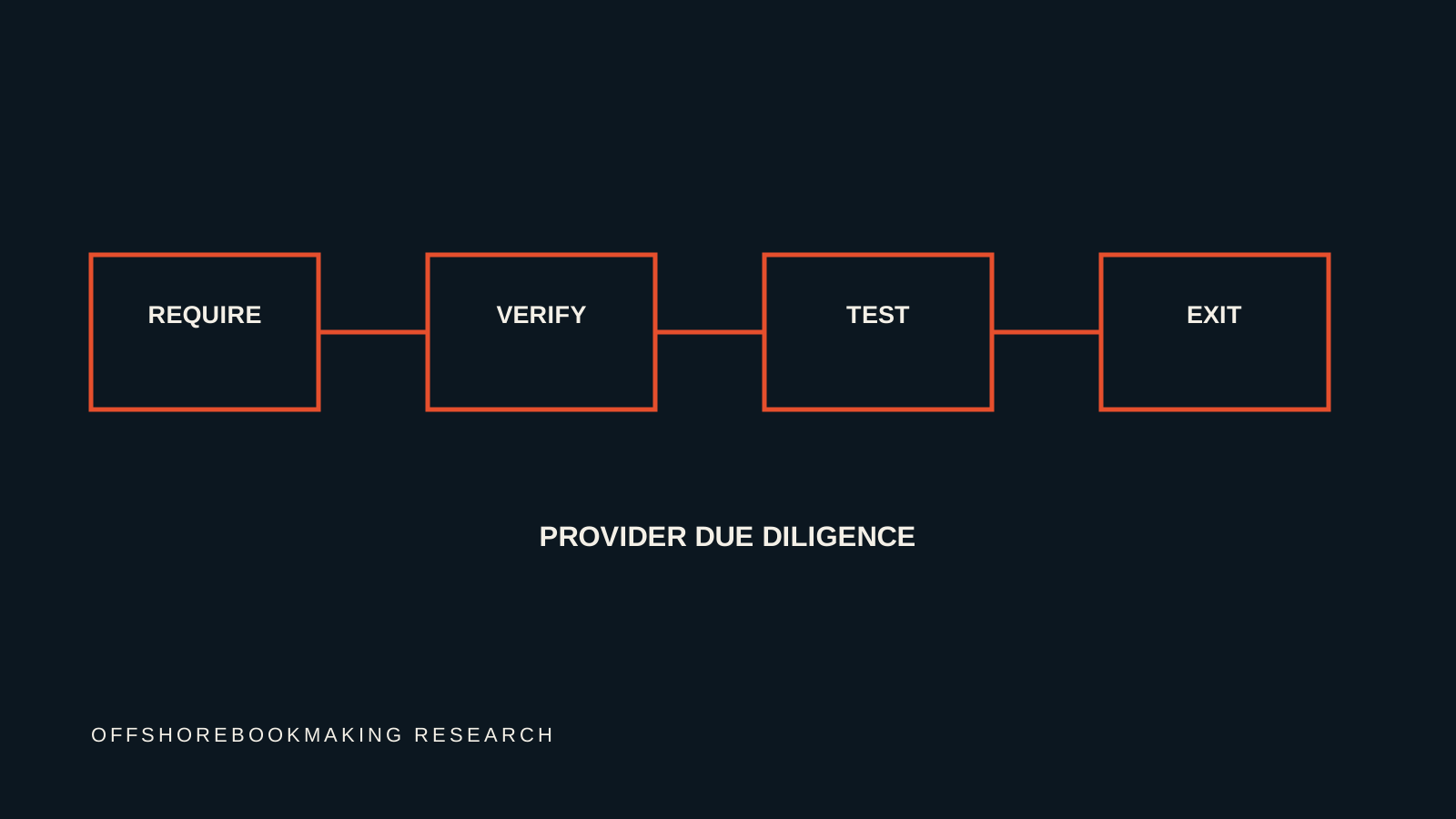
OffshoreBookmaking will evaluate providers through a repeatable sequence: define requirement, identify candidate capability, verify evidence, test integration, measure service behavior, normalize commercial terms and map the exit path. Each conclusion should retain its source and observation date because products, prices, partnerships and regulatory status change. Unknown information should remain unknown rather than be inferred from adjacent products or corporate reputation. Comparisons should also avoid declaring a universal best provider; suitability depends on the operator's market, architecture, scale and control requirements. This framework connects all five preceding desks. Technology defines interfaces, Data tests evidence, Operations allocates responsibility, Regulation establishes applicable permissions and Industry maps commercial relationships. Providers turns those perspectives into a practical research method for evaluating the companies that supply the sportsbook stack.