How Modern Sportsbook Technology Actually Works
A research framework for understanding the platform layers and infrastructure behind a modern sportsbook.
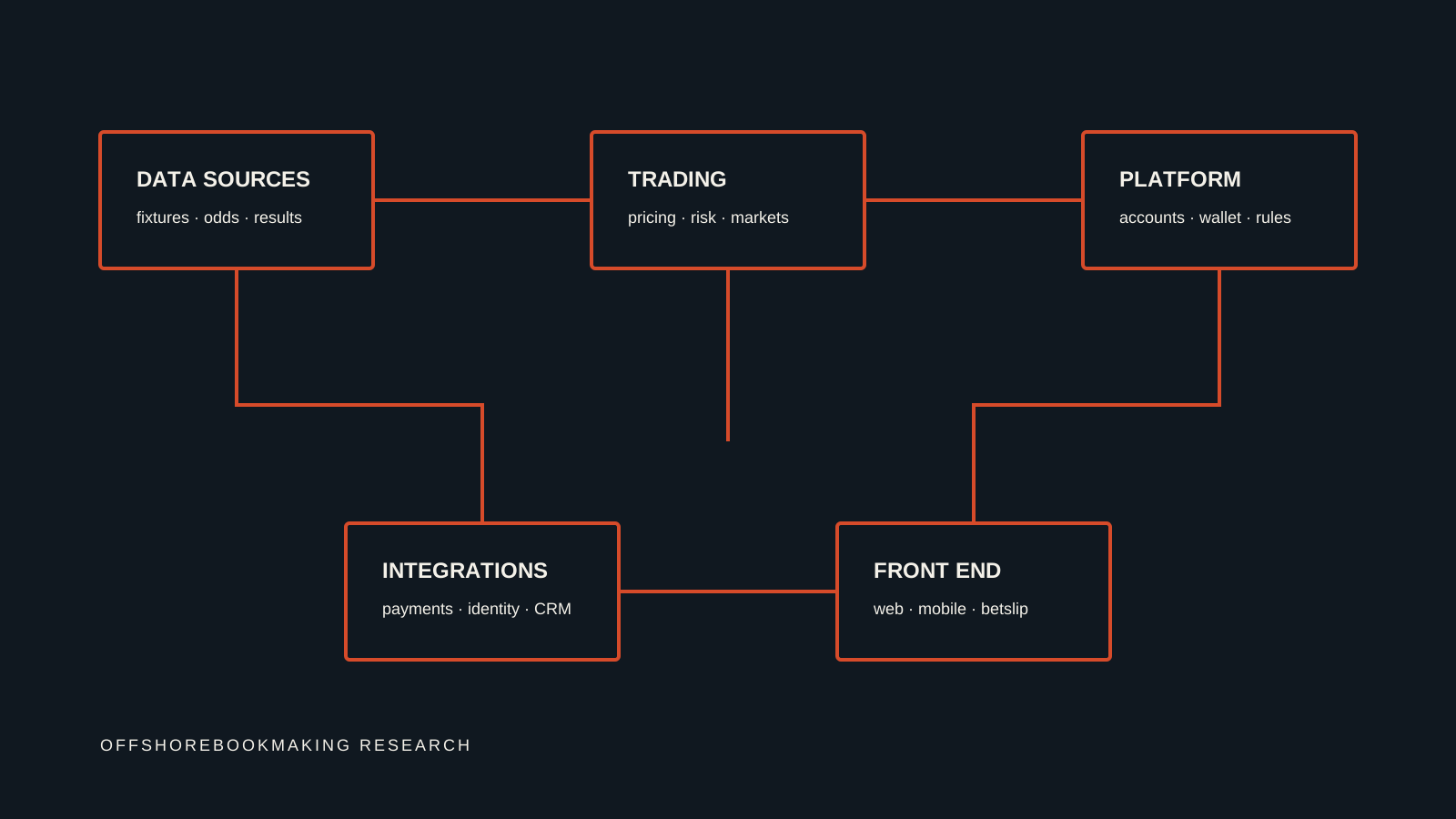
A sportsbook is a stack, not a single system
A modern sportsbook is better understood as a coordinated technology stack than as one application. The customer sees a single website or mobile interface, but every price, market and bet depends on several services completing work in the correct order. Event data must arrive and be matched to the right competition and participant. Trading logic must convert information into markets and prices. Account, wallet and permission services must establish whether a customer can transact. The bet must then pass validation, risk and limit checks before acceptance, while settlement services later determine the financial result. Around that core sit payments, identity, CRM, reporting, affiliate tracking and regulatory controls. Some operators own many of these components; others assemble them from specialist suppliers. The architectural question is therefore not simply which platform a sportsbook uses. It is which system owns each responsibility, how state moves between systems, and what happens when one dependency becomes slow, inconsistent or unavailable.
The data layer is the beginning of the product
Sportsbook infrastructure begins with data because a betting market cannot be more current than the information supporting it. Fixtures, participants, venues, start times, scores, statistics, incidents and market inputs can arrive from several suppliers as well as internal trading systems. Receiving a feed is only the first step. Operators must normalize team and competition identifiers, reconcile duplicate events, preserve source timestamps, distinguish corrections from new observations and decide which source is authoritative when providers disagree. Latency also has different meanings across the stack: a schedule update may tolerate seconds or minutes, while an in-play incident can make a stale price commercially dangerous. Mature architectures therefore record provenance and freshness rather than treating every received value as equally reliable. They also isolate downstream products from provider-specific schemas. That separation makes it possible to change a data supplier without rewriting every consumer and provides the foundation for the deeper research covered by the Data desk.
Trading systems turn information into markets
Trading is the layer where raw information becomes a commercial betting proposition. A trading service determines which markets exist, how selections are represented, what price is offered and when a market should be suspended or reopened. Pricing can be produced internally, supplied by a managed-trading partner, derived from reference markets or assembled through a hybrid model. Whatever the source, the quoted number is only one part of the system. Limits, exposure, customer segmentation, event status, market hierarchy, margin rules and settlement definitions all influence whether a wager can actually be accepted. Pre-match and live betting also create different engineering demands. In-play systems must react to fast event changes while protecting the operator from accepting bets against information that is already obsolete. For technology research, this means a claim such as “real-time trading” is not sufficiently descriptive on its own. Useful evaluation asks about latency, suspension logic, price provenance, manual controls, auditability and behavior during feed degradation.
The sportsbook platform owns transactional state
The platform coordinates the durable commercial state of the sportsbook. Accounts, balances, wagers, bonuses, permissions and settlement records must remain internally consistent even when surrounding services fail. A front end may display a price instantly, but the platform still has to verify that the market is open, the selection is valid, the stake is permitted and the customer has sufficient available funds. Once a bet is accepted, the transaction needs an authoritative record that can survive retries, network interruptions and later reconciliation. This is why platform architecture is closely tied to concepts such as idempotency, ledgers, event histories and clear ownership of state. Modular systems may distribute these responsibilities across multiple services, while more integrated products keep them inside a single vendor environment. Neither structure eliminates the need to understand boundaries. Operators evaluating technology should know where the definitive account balance lives, which service owns a wager, how settlement corrections propagate and how historical records can be reconstructed during an operational investigation.
Payments, identity and other integrations are part of the architecture
A sportsbook does not operate in isolation. Payment processors, identity and age verification, fraud controls, CRM platforms, affiliate systems, geolocation services, messaging tools and regulatory reporting services all connect to the core product. These integrations are sometimes described as peripheral features, but in practice they can determine whether a customer can register, fund an account, place a wager or withdraw. Integration design therefore affects both customer experience and operational resilience. Synchronous dependencies can create visible delays when an external service slows down; asynchronous workflows can improve resilience but require careful reconciliation and status handling. The same principle applies to data ownership. If customer, payment or compliance state is duplicated across several vendors, teams need explicit rules for which record is authoritative and how conflicts are resolved. Our Providers research will examine specialist suppliers individually, while the technology framework focuses on the interfaces between them: authentication, APIs, webhooks, queues, retry policies, versioning, monitoring and the operational procedures used when a third party is unavailable.
Front ends are presentation systems, not the whole sportsbook
The web and mobile experience is the most visible layer, which makes it easy to confuse interface quality with platform quality. A sportsbook front end has demanding responsibilities: it must organize thousands of events and markets, update prices without confusing the customer, maintain betslip state, communicate suspensions clearly and remain responsive across devices and network conditions. Yet it normally consumes state created elsewhere. If an upstream service provides stale prices, inconsistent event identifiers or an incorrect wallet balance, visual polish cannot repair the underlying problem. Strong front-end architecture therefore makes uncertainty visible and handles changing state deliberately. It distinguishes loading from unavailable data, prevents obsolete responses from overwriting newer ones and gives customers a clear result when a wager is repriced or rejected. Performance should also be measured beyond initial page load. Market update speed, interaction latency, payload size and recovery after connection loss can all affect usability. Technology assessment should connect these interface measurements to the services that produce the data.
Reliability depends on failure design
Every sportsbook architecture eventually encounters failures: feeds disconnect, provider APIs return errors, caches become stale, queues accumulate work and deployments introduce regressions. The important distinction is whether failure behavior has been designed in advance. A resilient system identifies critical dependencies, applies bounded timeouts, prevents uncontrolled retry storms and degrades functionality without silently presenting invalid state. Circuit breakers, queues, redundant sources and cached data can all help, but each mechanism introduces trade-offs. Cached odds, for example, may improve availability while creating unacceptable pricing risk unless freshness is explicit and betting is disabled when a threshold is exceeded. Operational teams also need runbooks that connect technical alerts to business consequences. A feed delay and a payment outage require different responses even if both appear as API errors. This is where Technology and Operations overlap: architecture determines what can fail independently, while operating procedures determine how humans respond. Evaluating a vendor therefore requires understanding not only its normal workflow but its documented behavior under partial failure.
Observability turns a complex stack into an operable system
Distributed systems are difficult to manage when teams can see only whether a page is online. Effective observability connects logs, metrics and traces to sportsbook concepts such as event, market, wager, account and provider. Engineers should be able to follow a transaction across service boundaries and determine where delay or inconsistency entered the workflow. Business-facing monitoring adds another layer: number of stale markets, rejected wagers, delayed settlements, payment failures or events missing a required source may be more useful than CPU utilization alone. Timestamps and correlation identifiers are especially important because sportsbook incidents often involve disputes about sequence. Teams need to know when a supplier produced an update, when the platform received it, when trading processed it and when the customer interface displayed it. This evidence supports troubleshooting, supplier management and post-incident review. It also creates a more rigorous basis for comparing technology providers, because service-level claims can be tested against measurable operational outcomes rather than marketing language.
Modular, turnkey and hybrid architectures create different dependencies
Sportsbook technology can be assembled in several commercial and technical forms. A turnkey environment may provide platform, trading, front end and integrations through one primary supplier. A modular operator may select separate vendors for major layers and build an integration fabric between them. Hybrid arrangements are common: an operator might control the customer interface and data model while outsourcing managed trading or wallet infrastructure. These choices influence speed to market, internal staffing, product flexibility and vendor concentration, but labels alone do not reveal the architecture. Two products sold as white label can expose very different levels of control, and two apparently modular stacks can still depend on a single vendor for critical state. Technology due diligence should therefore map actual responsibilities rather than relying on category names. The Operations desk examines the commercial operating models in greater depth; from a technical perspective, the key questions are ownership, portability, interface quality, data access, failure isolation and the practical cost of replacing a component later.
Security, permissions and change control cross every layer
Security is not a separate box that can be added after the platform is assembled. Identity, authorization, secrets, administrative permissions and audit records cross data, trading, account and integration services. A useful architecture limits the blast radius of both mistakes and compromised credentials. Administrative tools should distinguish viewing from changing sensitive state, production access should be attributable, and high-impact actions should leave durable records. The same discipline applies to software changes. A sportsbook is continuously changing because leagues, markets, providers, regulations and customer products evolve. Versioned interfaces, controlled deployments, rollback paths and compatibility testing reduce the chance that an update in one service unexpectedly breaks another. Third-party access deserves equal scrutiny: vendors may need production connectivity without needing unrestricted access to customer or trading data. Regulation can impose additional requirements depending on jurisdiction, but sound technical controls are valuable even before a specific rule is considered. Our Regulation coverage treats those legal obligations separately from the underlying engineering practices.
How to evaluate a sportsbook technology stack
A useful technology review starts by drawing the system as it actually exists. Identify the source of event and pricing data, the owner of trading decisions, the authoritative account and wallet records, the bet-placement path, settlement ownership, customer interfaces and every external service that can block a transaction. Then document interfaces and failure modes. Which calls are synchronous? Which workflows can be retried safely? How is stale information identified? Can a supplier be replaced without changing canonical identifiers or historical records? What evidence exists for latency and availability claims? The answers reveal more than a feature checklist because they show where operational and commercial dependency resides. OffshoreBookmaking will use this framework across future Technology, Data, Operations and Providers research. The objective is not to declare one universal architecture correct. Different operators have different markets, resources and regulatory obligations. The objective is to make the structure visible enough that readers can compare systems on documented responsibilities, interfaces, resilience and control rather than treating every sportsbook platform as an interchangeable black box.