Sportsbook Operations: Wager Lifecycle, Settlement and Reconciliation
How wager placement, validation, acceptance, grading, wallet settlement, reconciliation and disputes fit into one controlled operating lifecycle.
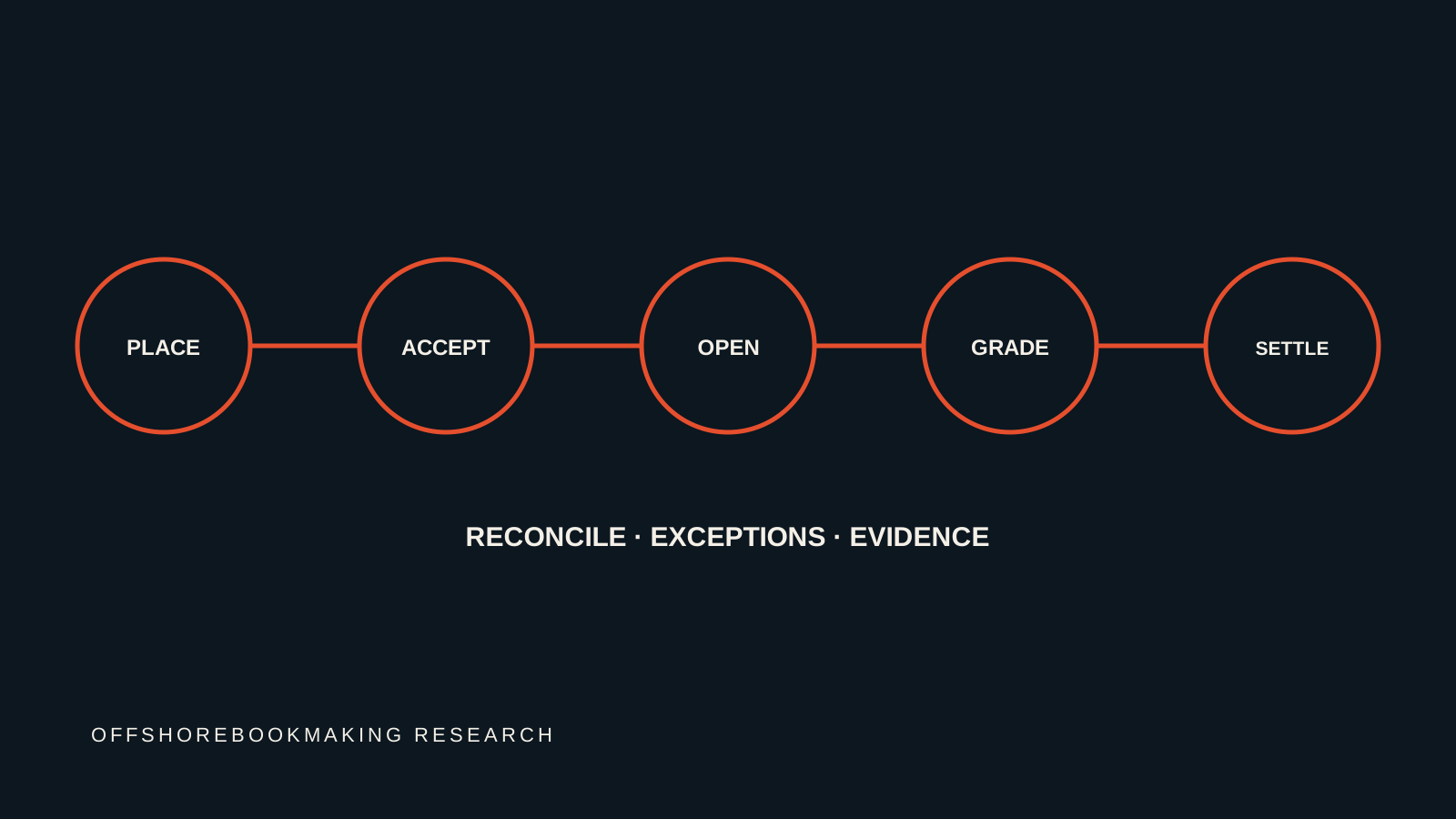
A wager is a lifecycle, not a database row
A sportsbook wager moves through a sequence of business states. The customer constructs a bet, the platform validates it, the trading layer checks price and availability, the wallet confirms funds, the sportsbook accepts or rejects the request, and an accepted wager remains open until its underlying event can be graded. Settlement then changes both wager state and financial state. Treating that process as one database insert hides the operational controls needed at each transition. OffshoreBookmaking models the wager as a lifecycle because every stage creates evidence: requested terms, accepted terms, timestamps, balance effects, event identity and later grading inputs. When a dispute occurs, operations should be able to reconstruct the sequence rather than infer it from the final status. The lifecycle is therefore both a customer workflow and an audit trail.
Placement begins with a precise bet identity
Before accepting a wager, the system must know exactly what the customer is attempting to buy. Bet identity includes canonical event, market, period, outcome, line where applicable, accepted price, stake, currency and the sportsbook's market rules. This connects directly with Data's odds-normalization model. A displayed quote can change between page render and submission, so the server should validate the wager against current authoritative state rather than trust values supplied by the browser. Parlays add another layer because every leg requires its own identity and the combination may have eligibility rules. The placement record should preserve the terms actually accepted, not merely a pointer to a market whose current values can later change. That frozen evidence becomes essential when reconstructing settlement or answering a customer dispute.
Validation happens across several operating controls
A syntactically valid wager can still be operationally invalid. The account may be restricted, the market suspended, the event started, the price stale, the stake outside limits or the requested combination prohibited. Validation may therefore involve account status, jurisdictional controls, market state, trading limits, wallet availability and product rules. These checks should produce explicit outcomes rather than a generic failure whenever practical. Ordering also matters. Expensive downstream calls need not occur if an earlier control already makes acceptance impossible. At the same time, controls that affect money or permission should not be bypassed because a dependency is slow. The API architecture article's fail-closed principle is particularly important here. Operations needs a documented matrix showing which service owns each validation and what happens when that service cannot answer.
Acceptance must freeze the commercial terms
Sportsbook prices can move rapidly. A customer might submit -110 while the trading engine changes to -115 milliseconds later. The acceptance workflow needs a deterministic rule for which price becomes contractual. Some systems reject changed prices, some allow customer-configured tolerance and others return a revised offer requiring confirmation. Whatever policy applies, the accepted wager should preserve its exact price, line, stake and acceptance time. The system should also assign a stable wager identifier before ambiguous network retries can create duplicates. Idempotency at the API boundary protects the same intended wager from being placed twice when a response is lost. The operational objective is simple: both customer and sportsbook should be able to identify one accepted transaction and the precise terms attached to it.
The wallet should record financial movements as a ledger
Balances are easier to audit when they are derived from explicit transactions rather than repeatedly overwritten totals. Wager acceptance may create a debit or reserve, settlement may create a credit, and cancellation may release funds. Each movement should have its own immutable identity and reference the business action that caused it. The visible balance can be a projection of those ledger entries, but operations should be able to reconcile the projection back to history. This architecture helps detect duplicate postings and supports investigation when a wager state and wallet state disagree. Currency must also be explicit. A sportsbook serving multiple currencies should not assume that numeric amounts are comparable without currency identity and conversion evidence. Financial reconciliation begins with preserving the movements that produced the balance.
Open wagers depend on changing event state
After acceptance, many wagers remain open for minutes, hours or days. During that period the underlying event can be delayed, postponed, abandoned, corrected or rescheduled. Markets may also be suspended while the wager itself remains valid. Operations needs to distinguish market availability from the status of an already accepted bet. Event-state feeds provide evidence, but house rules determine the operational consequence of many scenarios. A postponed game might remain actionable under one rule set and become void under another. The platform should therefore retain the applicable rule context or version rather than relying only on whatever rules page exists later. Automated monitoring can identify wagers affected by event changes and route ambiguous cases for review. Open-wager management is where data quality, trading decisions and operating rules meet.
Grading converts event evidence into a wager outcome
Grading determines whether a wager wins, loses, pushes, voids or enters another supported terminal outcome. It should be based on canonical event and market identity plus an authoritative result appropriate to that market. A final game score may be enough for a full-game moneyline but insufficient for a first-inning total or player proposition. The grading engine therefore needs result data at the same semantic granularity as the wager. Rules around overtime, shortened games, dead heats or abandoned events can also affect the outcome. Automated grading should record the result evidence and rule applied. If a result is later corrected, the system needs a controlled regrade process rather than an unexplained overwrite. A wager's final state should be reproducible from accepted terms, result evidence and applicable rules.
Settlement connects grading to the financial ledger
Grading answers what happened to the bet; settlement applies the financial consequence. Keeping these concepts distinct makes failures easier to diagnose. A wager can be correctly graded while its wallet credit fails, or a wallet transaction can post while the wager status update is delayed. Settlement workflows should therefore use stable references and idempotent financial operations. A winning payout should not be duplicated because a worker retries after a timeout. The wager and ledger records should also expose whether settlement is pending, completed or reversed. In high-volume periods, asynchronous settlement can process large result batches without forcing every update into one synchronous transaction, but operations then needs queues, monitoring and reconciliation to prove completion. Speed matters to customers, yet correctness and recoverability matter more than pretending distributed systems never fail.
Reconciliation proves that independent records still agree
A sportsbook may hold related evidence in the wager database, wallet ledger, trading service, result feed and external payment systems. Reconciliation compares those records according to defined invariants. Every settled wager should have the expected financial posting. Every wallet posting attributed to a wager should reference a valid wager. Aggregate debits and credits should reconcile to the underlying transaction set. Exceptions should be recorded with type, amount, identifiers and discovery time. The process should be repeatable so a correction can be verified on the next run. Reconciliation is not simply an accounting task performed at the end of the month; critical checks can run continuously or in bounded batches. The purpose is to find divergence before it becomes customer-visible or compounds into larger financial uncertainty.
Exceptions need queues, ownership and evidence
Not every case can be resolved automatically. Conflicting results, interrupted settlements, duplicate provider messages, missing wallet postings and unusual event rulings may require human review. An exception system should create a durable case rather than rely on chat messages or private notes. The case needs severity, owner, related identifiers, evidence, timestamps, actions and resolution. Operations should distinguish a temporary retryable failure from a business decision requiring authorization. Manual corrections must themselves be auditable transactions, not direct edits that erase the original problem. Escalation paths are especially important when an external provider controls part of the evidence. The Providers desk's support framework becomes relevant here: the operator needs to know whom to contact, what evidence to send and how the provider's response becomes part of the case history.
Disputes should reconstruct the accepted wager from evidence
Customer disputes often concern price, line, timing, settlement or balance. A strong operational system can answer those questions without relying on screenshots supplied by either side. The wager record should show the accepted terms and time, while market observations can show surrounding price history. Event and result records establish what occurred, the rules version explains how it should be graded, and ledger entries show the financial effect. Support staff should see this evidence through controlled tools without receiving unnecessary access to production databases. If a correction is warranted, the adjustment should reference the dispute or exception case. This creates a chain from complaint to evidence to decision to financial action. Good dispute handling is therefore a consequence of good data architecture established long before a customer opens a ticket.
A practical operating model for wager settlement
OffshoreBookmaking will evaluate sportsbook wager operations as a connected state machine. Placement establishes canonical bet identity. Validation proves the wager is permitted and executable. Acceptance freezes commercial terms and creates a stable wager record. The ledger records the financial commitment. Event monitoring preserves context while the bet remains open. Grading applies result evidence and rules; settlement posts the financial consequence through idempotent transactions. Reconciliation checks that wager and wallet states agree, while exception queues preserve ambiguous cases for controlled review. Finally, dispute tooling reconstructs the lifecycle from evidence. This model connects Operations directly with Data's market identity, Technology's API and retry controls, Providers' service responsibilities and Regulation's requirements for records and customer treatment. Reliable settlement is not one calculation after a game ends; it is the outcome of disciplined controls across the entire wager lifecycle.