Sportsbook Licensing and Regulatory Structures Explained
A research framework for understanding jurisdictions, licences, compliance responsibilities and regulatory architecture.
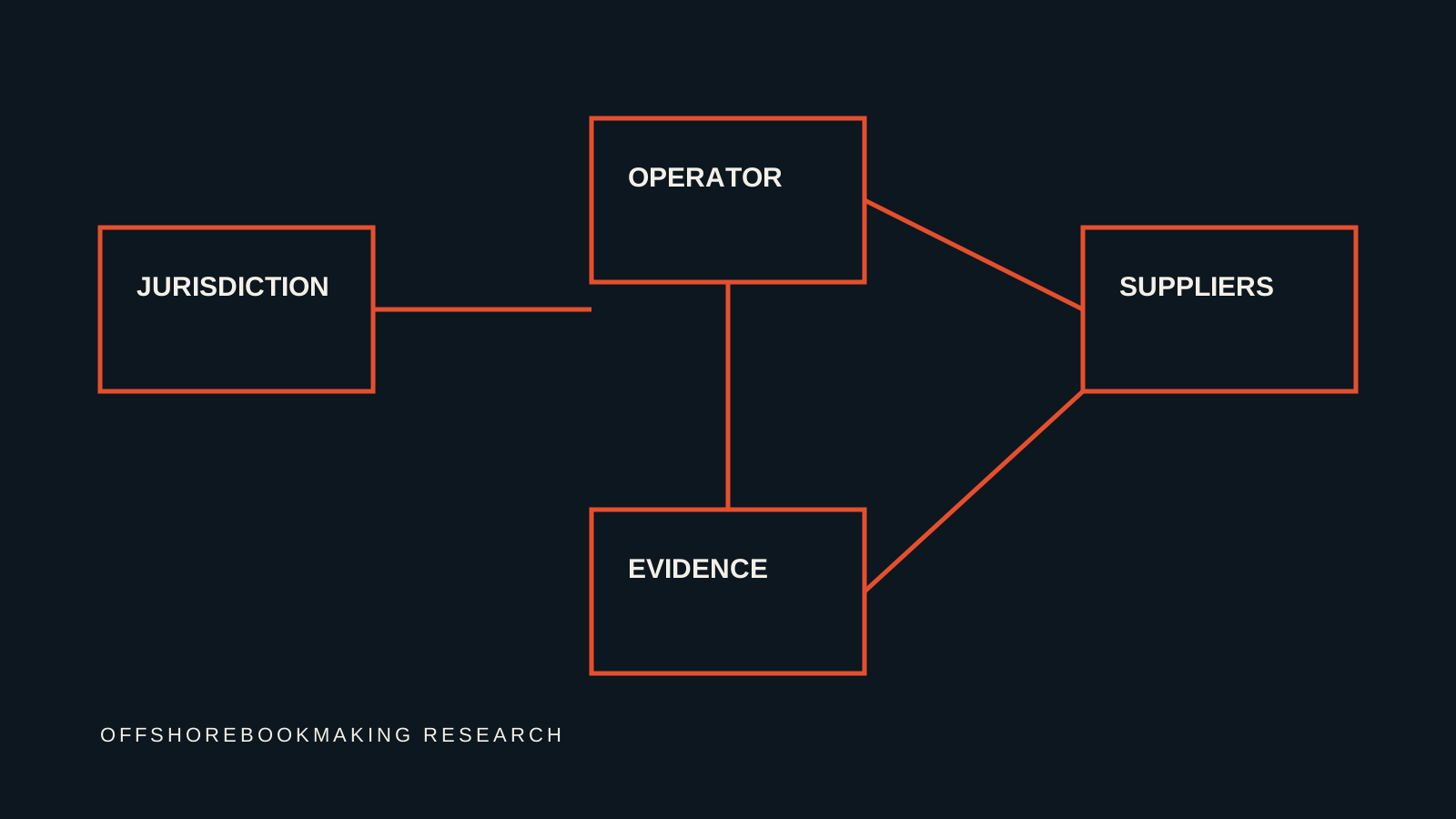
Regulation begins with jurisdiction, not with a logo
Sportsbook regulation is not one universal system. The first question is which jurisdiction governs a particular activity, customer relationship, company and technical function. A licence displayed by a business can be meaningful, but its significance depends on what the licence authorizes and where. Regulators may distinguish remote and non-remote gambling, betting and other gambling products, operators and software suppliers, or management and functional roles. Great Britain, for example, requires an operating licence for businesses providing gambling facilities to British consumers, while its framework separately addresses gambling software and personal licences. That illustrates why OffshoreBookmaking treats regulation as an architecture problem. A useful regulatory map connects legal entities, markets, customers, products, systems and suppliers. The task is to identify which permission attaches to which activity rather than treating the word licensed as a complete description of a sportsbook.
Operator licensing and supplier licensing are different layers
A sportsbook can depend on several regulated businesses at once. The customer-facing operator may require authorization to provide betting, while a software company may require a different permission to manufacture, supply, install or adapt gambling software. Other jurisdictions use different categories, so these labels cannot simply be copied across borders. The distinction matters commercially because outsourcing technology does not necessarily outsource regulatory responsibility. In Great Britain, the Gambling Commission states that a gambling software licence does not itself authorize a business to provide gambling facilities; a business doing both can require the relevant permissions for both activities. This separation is a useful research principle even where the legal categories differ. When reviewing a platform, white-label or turnkey arrangement, the operator should identify every regulated function, the entity performing it and the evidence that the entity is authorized for that role in the target market.
Point of consumption changes how offshore architecture is evaluated
Internet infrastructure can be located far from the customer, but regulatory obligations may follow the market being served rather than the physical server alone. Great Britain's framework is a clear example: remote businesses serving British consumers fall within its licensing regime under specified conditions. Other jurisdictions define market access differently, which means a licence from one territory should never be assumed to authorize solicitation or service everywhere else. This is particularly important for offshore structures, where incorporation, hosting, payment processing, trading and customer acquisition may occur in different countries. A regulatory inventory should therefore record the location and role of each legal entity, the markets targeted, customer eligibility rules, domain strategy and the systems used to enforce geographic restrictions. The purpose is not to create a universal legal conclusion. It is to expose where market-entry assumptions need jurisdiction-specific legal review before launch or expansion.
KYC is a system workflow as well as a compliance requirement
Identity verification is often described as a compliance checkbox, but operationally it is a sequence of data collection, decisions and evidence. A sportsbook must know what information is required under its applicable rules, when verification must occur, which provider performs checks, how exceptions are handled and what happens when information cannot be verified. The UK Gambling Commission's current Licence Conditions and Codes of Practice include customer identity verification among requirements for relevant licensees. The technical architecture therefore needs consistent customer identifiers, status fields, timestamps and audit records so that account access and transaction controls reflect the compliance decision. If an external identity provider is used, the operator still needs a durable record of the result and the basis for downstream actions. OffshoreBookmaking connects this requirement with Technology and Operations because weak integration between compliance tooling and account state can create a gap between a written policy and the behavior of the live product.
AML controls require risk assessment and traceable decisions
Anti-money-laundering obligations vary by jurisdiction and activity, but modern regulatory frameworks increasingly require businesses to understand financial-crime risk rather than rely on a single transaction threshold. In Great Britain, the Gambling Commission requires operators to comply with applicable anti-money-laundering legislation and regulatory codes, and it publishes sector risk material. FATF's September 2026 work on gaming and gambling also highlights risks associated with increasingly digital, cross-border and interconnected services. For a sportsbook, the architecture question is how risk information moves through customer accounts, payments, monitoring, review and reporting. A useful control model records why an alert was created, what information an analyst reviewed, what decision followed and when restrictions changed. Providers may supply screening or monitoring tools, but the operator should understand data coverage, update frequency, escalation paths and retention. Compliance evidence should survive supplier changes rather than exist only inside a vendor dashboard.
Player protection must be translated into product behavior
Regulatory frameworks can impose requirements concerning minors, vulnerable customers, fair and open treatment, marketing, complaints and other player-protection matters. The UK Gambling Commission's current LCCP, for example, contains code provisions covering protection of children and vulnerable persons, marketing, complaints and disputes, alongside operating conditions. The exact requirements differ across markets, so implementation must begin with the applicable rule set. From a systems perspective, player protection can touch registration, deposits, wagering, messaging, bonuses, account restrictions and customer support. A policy document is not sufficient if the platform cannot enforce the resulting state consistently. Teams should know which service is authoritative for restrictions, how changes propagate to web and mobile interfaces, and how an intervention is recorded. This is another reason regulatory design should be part of platform architecture rather than a layer added after the commercial product is already built.
Customer funds and wallet controls can carry regulatory consequences
A sportsbook wallet is both a product feature and a financial record. Depending on the jurisdiction, rules can govern how customer funds are held, disclosed, reconciled or protected. In Great Britain, for example, most remote operators holding customer funds are subject to segregation requirements under the Gambling Commission's licence conditions, with defined exceptions. That example should not be generalized to every jurisdiction, but it demonstrates why the wallet architecture belongs in regulatory due diligence. Operators need to identify the legal entity holding customer money, the bank or payment relationships involved, the ledger that represents customer balances and the process used to reconcile external cash movements with internal records. A platform migration or provider failure should not destroy the ability to reconstruct liabilities. Operations, finance and compliance therefore need the same canonical transaction history, rather than separate spreadsheets that only agree under normal conditions.
Technical standards turn regulation into engineering requirements
Some regulators prescribe or reference technical standards for remote gambling systems and testing. The UK Gambling Commission requires relevant gambling software and remote operating licensees to comply with its remote technical standards and describes testing requirements for software made available under its licences. The important architectural lesson is broader than any one standard: regulatory obligations can affect release management, change control, logging, security, transaction recording, settlement and testing. A product team should know which changes require internal approval, external testing, notification or other regulatory treatment before deployment. Supplier contracts should also define who produces technical evidence when the regulated operator does not own the underlying code. This becomes especially important in modular stacks where the front end, platform, trading service and data feeds are controlled by different companies. Compliance cannot depend on an assumption that another vendor has handled the relevant requirement.
Reporting and auditability depend on data design
Regulators can require periodic reports, event notifications, records or information on request. Those obligations become expensive when the underlying systems were not designed to preserve consistent identifiers and timestamps. A strong regulatory data model records the customer, event, wager, market, transaction and decision identifiers needed to reproduce what happened. It also distinguishes effective time from the time a record was observed or changed. This aligns with the Data desk's emphasis on provenance: an audit trail should make it possible to understand which source supplied information and which system transformed it. Retention rules vary, so the required period must be established for each jurisdiction and record class. The objective is not indefinite collection. It is deliberate retention tied to an identified obligation, with access controls and deletion processes that also respect applicable privacy requirements. Good reporting starts with data architecture long before the first regulatory return is due.
Outsourcing does not erase the need to map responsibility
White-label, Pay Per Head and turnkey structures can move substantial operational work to suppliers, but the regulatory analysis still needs to identify who is responsible for each function. The Operations desk maps commercial and technical ownership; Regulation adds the applicable permissions, controls and evidence. Contracts should state who performs identity checks, transaction monitoring, customer support, trading interventions, incident response, regulatory reporting and record retention. They should also explain how the operator can inspect or export evidence. A service-level agreement about uptime does not answer a compliance question about a customer decision. Similarly, a vendor's licence should not be assumed to cover every activity of the operator. The correct allocation depends on the jurisdiction and contract. The practical goal is a responsibility matrix that can be tested against real scenarios, including supplier outage, disputed wager, failed verification, suspicious transaction review, security incident and termination.
Licensing due diligence should test substance, scope and status
A licensing review should verify more than a licence number copied from a footer. Researchers and operators should identify the issuing authority, licensed legal entity, licence type or authorized activities, status, relevant domain or trading name where applicable, and any material conditions that affect the proposed service. The regulator's own register or documentation is generally the appropriate starting point when available. The review should then compare that scope with the actual operating model. If one company contracts with customers while another supplies software or trading, each role should be mapped separately. Corporate group membership does not automatically make permissions interchangeable. Because regulatory status and rules can change, the evidence should also carry an observation date. OffshoreBookmaking will use this approach in future jurisdiction and provider research so that claims about regulation can be traced to a specific authority, entity, scope and point in time rather than repeated from marketing material.
A regulatory framework for future OffshoreBookmaking research
The Regulation desk will treat licensing as a structured research problem: jurisdiction, activity, entity, permission, responsibility, control and evidence. For each market, research should begin with primary regulatory material and clearly separate current requirements from interpretation. Comparisons should state the date reviewed because licence conditions, technical standards and enforcement expectations evolve. The framework will connect with Technology when a rule becomes a system requirement, with Data when evidence and retention matter, and with Operations when responsibility is outsourced. It will also distinguish operator requirements from supplier requirements instead of assuming that one licence describes an entire sportsbook stack. This first article is therefore a foundation rather than legal advice or a universal checklist. Its purpose is to make the questions explicit enough that future jurisdiction-specific work can document the actual rules, responsible authority and operational consequences without flattening materially different regulatory systems into a single offshore licensing category.