Sportsbook Compliance Controls: From Regulation to Operations
How identity, AML, player protection, customer funds, technical standards, records, reporting and supplier oversight become operating controls.
Compliance is an operating system, not a licence certificate
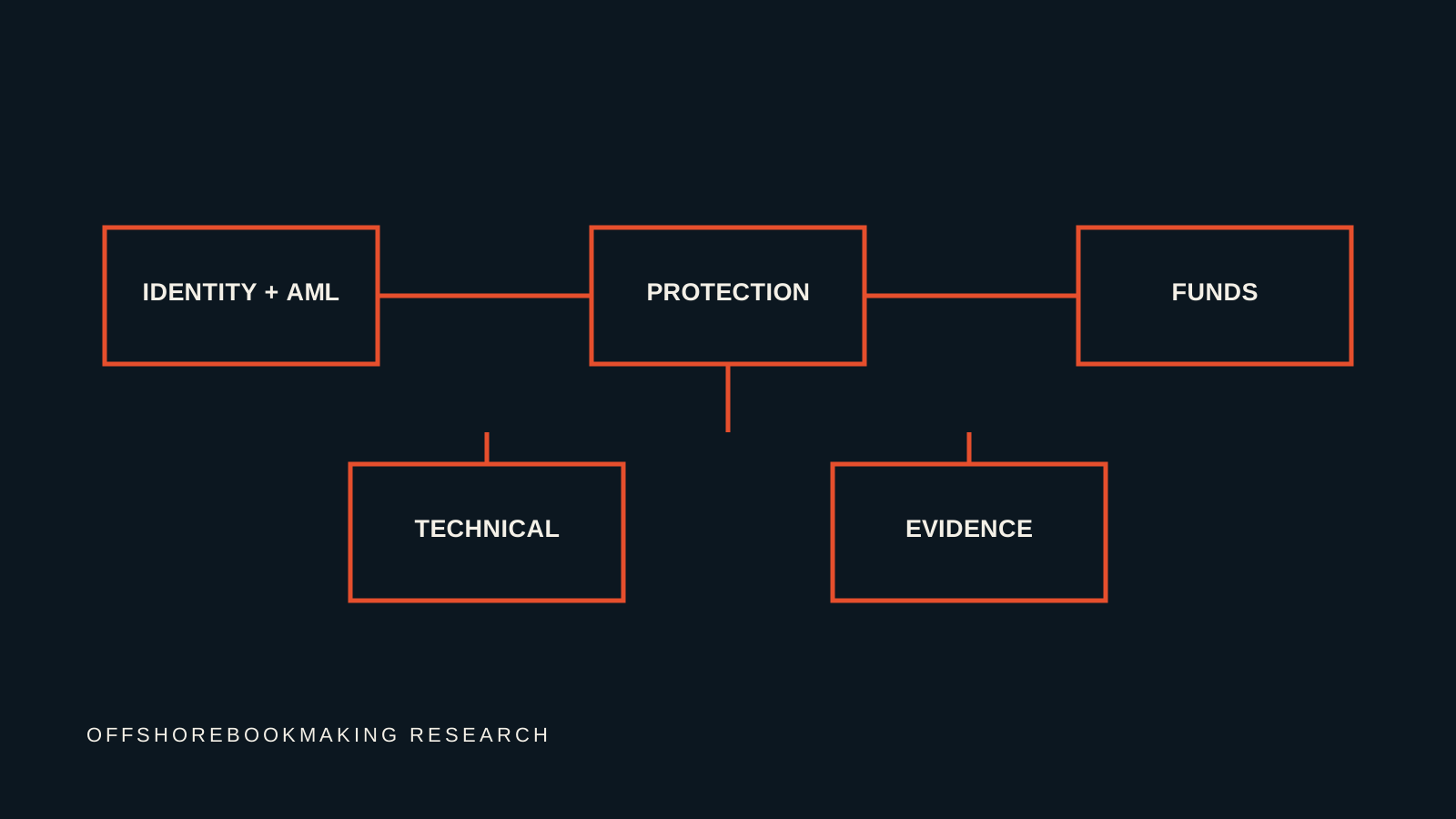
A sportsbook can hold a licence and still fail operationally if regulatory obligations are not translated into day-to-day controls. Compliance therefore belongs inside account creation, payments, trading, customer support, security, recordkeeping and supplier management rather than in a document reviewed only during audits. Requirements vary materially by jurisdiction, licence type and customer location, so no universal checklist can substitute for the rules that actually apply to an operator. A useful operating model starts by mapping each obligation to a control, an owner, evidence and an escalation path. That structure turns abstract requirements into something testable. It also helps distinguish a policy that merely exists from a control that is actually executed. OffshoreBookmaking treats regulation as an architecture of responsibilities because the strongest evidence of compliance is usually produced by ordinary systems while they operate.
Customer identity controls begin before gambling activity
Identity and age controls are foundational because later monitoring depends on knowing which customer and accounts are involved. In Great Britain, for example, the Gambling Commission's current remote licence conditions require covered licensees to obtain and verify customer identity information before permitting gambling, while its social-responsibility provisions require age verification before covered remote customers can deposit, access free-to-play gambling games or gamble. Other jurisdictions may use different thresholds, data requirements and timing. Operationally, the lesson is broader than one regime: onboarding should capture the evidence required by the applicable rules, record verification outcomes and preserve the relationship between a person and their accounts. Failed or incomplete verification needs a deterministic state rather than an informal workaround. Changes to customer information should also be governed so that identity evidence remains useful after registration.
KYC and AML are related but not identical controls
Know-your-customer processes establish and maintain customer identity, while anti-money-laundering controls evaluate financial-crime risk and suspicious activity under the applicable framework. The two interact, but collapsing them into one verification checkbox creates blind spots. AML programs may consider payment behavior, source information, transaction patterns, account relationships, geographic exposure and other risk indicators. In September 2026, the Financial Action Task Force highlighted emerging gaming and gambling risks associated with increasingly digital, cross-border and interconnected services, including misuse of multiple accounts and payment methods, identity discrepancies and suspicious transaction patterns. That international risk work does not itself define every operator's legal obligations; domestic law and licence conditions remain decisive. A sportsbook therefore needs jurisdiction-specific rules plus systems capable of retaining the evidence used to identify, assess, escalate and resolve risk.
Multiple accounts can change the meaning of customer behavior
Monitoring one account in isolation can miss the activity of the person behind it. Regulators may require or expect operators to connect accounts held by the same customer for particular controls. Great Britain's current remote social-responsibility code, for example, requires covered licensees that permit multiple accounts to relate them and apply specified protections across them, including self-exclusion and certain monitoring and limits. The operational challenge is identity resolution: systems need a stable customer-level object above individual usernames or wallets. That same architecture can improve fraud detection and support, but regulatory use should follow the applicable legal basis and data-governance rules. False matches can be harmful, so linkage should preserve confidence and evidence. A canonical customer relationship is conceptually similar to canonical event identity in sportsbook data: several external records may represent one underlying entity, but the reconciliation must be defensible.
Player protection must be implemented as product behavior
Player-protection obligations cannot be satisfied only by publishing responsible-gambling text. Depending on jurisdiction, operators may need age controls, self-exclusion, customer interaction, financial or time limits, marketing restrictions and other safeguards. The exact duties vary, and products should not assume that one jurisdiction's configuration is portable everywhere. Operational design should make protective states enforceable across relevant surfaces. If an account is self-excluded, a frontend banner is not enough if another product or account still accepts activity that should be blocked. Controls need shared identity, reliable state propagation and auditable decisions. This creates direct dependencies between Regulation, Technology and Operations. A compliance team can define the rule, but engineering must ensure that the rule survives API calls, retries, multiple products and supplier boundaries. Evidence should show both the decision and whether downstream systems actually enforced it.
Customer funds require financial controls as well as disclosure
Where a regulatory regime imposes requirements concerning customer funds, accounting architecture becomes part of compliance. Great Britain's Gambling Commission, for example, requires most covered remote operators holding customer funds to segregate them in separate client bank accounts and also imposes related disclosure and reporting requirements. That rule should not be generalized to every jurisdiction, but it illustrates why the sportsbook ledger, bank arrangements and customer-facing disclosures cannot be designed independently. Operations needs to identify what money is considered customer funds, reconcile internal balances to external accounts and preserve evidence for reporting. The wallet model discussed in the Operations desk becomes especially important: immutable transaction history makes it easier to explain how a displayed balance was produced. Regulatory controls are stronger when financial records can be independently reconciled rather than reconstructed manually after an examiner asks a question.
Technical standards turn software behavior into compliance evidence
Some regulators impose technical standards on remote gambling systems and testing. In Great Britain, covered remote gambling and software licence holders are subject to the Gambling Commission's Remote Gambling and Software Technical Standards, including security requirements for critical systems. The Commission's current security framework references relevant ISO/IEC 27001:2022 controls and includes systems handling sensitive customer information, balances, gambling state and connected networks. Its testing strategy also establishes circumstances for independent testing and audit. The broader architectural lesson is that compliance-sensitive functionality should be identifiable in the system inventory. Operators need to know which services store customer data, determine wager state, move money or connect to critical systems. Change management, access control, incident handling and supplier relationships then become measurable controls rather than generic security aspirations. Technical compliance begins with knowing exactly what infrastructure performs regulated functions.
Records should be designed for retrieval, not merely retention
Keeping data is not the same as being able to produce useful records. Regulatory, customer-service and audit requests often require a coherent history of account activity, wagers, payments, decisions and communications. Great Britain's remote technical standards provide a concrete example: covered customers must have easy access to specified account and gambling history, including bets, results, winnings and relevant credit and debit information, with defined availability periods. Other regimes use different retention and access requirements. A sportsbook should therefore classify records by purpose, authority, retention period and retrieval path. Timestamps, identifiers and provenance matter because disconnected logs are difficult to explain. The wager-lifecycle architecture from Operations provides a natural foundation: accepted terms, grading evidence, settlement entries and adjustments already form a traceable chain. Compliance adds rules governing how long evidence is retained, who can access it and how it is produced.
Reporting needs a controlled source of truth
Regulators can require periodic returns, incident reports, suspicious-activity processes, technical audit material or notification of defined events. The exact reporting catalogue depends on jurisdiction and licence. A common operational failure is to build reports from ad hoc spreadsheets whose definitions differ from production systems. A stronger model defines each metric and report field against canonical data sources, records the extraction period and preserves the submitted version. Corrections should be traceable rather than silently replacing history. Material events also need escalation logic so that the organization can determine whether a reporting obligation has been triggered. Security incidents illustrate the connection: Great Britain's Gambling Commission notes that information-security breaches may constitute reportable key events for licensees. Compliance reporting therefore depends on observability and incident management, not simply on a calendar reminder.
Suppliers do not automatically transfer responsibility away from the operator
Modern sportsbooks rely on platform vendors, identity services, payment processors, sports-data feeds, trading services, hosting and other specialists. Outsourcing a function does not necessarily outsource the operator's regulatory accountability. The applicable licence and contract determine responsibilities, but operators generally need to understand which supplier performs each critical control and what evidence is available. Great Britain's current remote security standards explicitly include controls concerning supplier relationships, supplier agreements, ICT supply chains and monitoring of supplier services. Due diligence should therefore examine more than features and price. Contracts may need audit rights, incident notification, data handling obligations, service levels, change controls and exit provisions. The Providers desk evaluates commercial and technical portability; Regulation adds the question of whether the operator can demonstrate control over regulated functions even when another company supplies the technology.
Exceptions and manual decisions need governance
Automated controls will eventually encounter ambiguous cases. Identity verification can fail despite legitimate documents, transaction monitoring can generate false positives, a self-exclusion match can be uncertain, or a technical incident can require temporary operating decisions. Compliance architecture should define who may override or resolve these cases, what evidence is required and whether a second approval is necessary. Manual action should create an auditable event rather than edit away the original state. This mirrors the exception queues described in sportsbook Operations. The distinction is that regulatory exceptions may also affect reporting, customer treatment or legal obligations. Case tooling should preserve the original signal, investigation, decision, actor and timestamps. Patterns across cases can then reveal weak controls or supplier problems. Human review is not a failure of automation; unmanaged human discretion is the risk.
A practical regulatory control framework for sportsbooks
OffshoreBookmaking will analyze sportsbook compliance by connecting obligations to operating evidence. First identify the jurisdictions, licence types, products and customer populations that determine applicable rules. Map each requirement to a named control and owner. Build identity and age verification into onboarding, and keep AML risk assessment distinct while allowing both to use reliable customer identity. Implement player-protection states across products. Connect customer-fund obligations to ledger and reconciliation architecture. Inventory critical technical systems and the suppliers that touch them. Design records so they can be retrieved, not merely stored, and generate regulatory reports from controlled sources of truth. Route exceptions through auditable cases and preserve evidence of manual decisions. Finally, review controls when regulations, products or suppliers change. This is not legal advice and no single jurisdictional example defines a universal standard; it is an operating framework for understanding how regulatory requirements become software, process and evidence.