Sportsbook Odds Normalization: From Raw Feeds to Comparable Markets
How event identity, market taxonomy, price formats, timestamps and reconciliation turn raw sportsbook odds into reliable comparison data.
Odds data is not one number
A sportsbook price is meaningful only when its surrounding market identity is known. American odds of -110 cannot be compared safely until the system knows the event, participant or outcome, market type, line, period, side, sportsbook, timestamp and status. The same displayed number can represent a full-game spread, a first-half total or a team total. OffshoreBookmaking therefore treats an odds quote as a structured observation rather than a loose value. That principle is foundational for comparison engines, line-history databases and trading analysis. If the identity surrounding a quote is incomplete, downstream software may still render a plausible table while comparing different economic propositions. Data quality begins before calculating a best price: it begins by proving that the observations belong to the same canonical market.
Event identity is the first reconciliation layer
Different providers rarely use the same event identifier. They may also format team names, competition names, start times and neutral-site information differently. A comparison system needs an internal event identity that survives those differences. Mapping should use stable evidence such as sport, competition, participants, scheduled start and provider identifiers, with explicit handling for postponements, doubleheaders and rescheduled games. Names alone are insufficient because abbreviations and aliases collide. Time alone is insufficient because schedules move. Once an event is confidently resolved, the provider-to-canonical mapping should be persisted rather than repeatedly guessed. Uncertain matches should remain unresolved. This is the same identity principle used in API architecture: external IDs are valuable provenance, while the canonical object belongs to the system performing reconciliation.
Market taxonomy determines what can actually be compared
Moneyline, spread and total are broad labels, not complete market identities. Sportsbooks may offer full game, halves, quarters, periods, innings, team totals, alternate lines, player props and many other structures. A normalized taxonomy should encode the period, market family, participant scope and line where applicable. For baseball, first inning and first five innings cannot be collapsed into one partial-game category. For hockey, regulation-time moneyline and a market including overtime can have different settlement rules. A comparison engine must therefore normalize semantics, not merely text labels. When a provider introduces an unfamiliar market, fail-closed behavior is safer than forcing it into the closest known category. Unknown markets can be stored for analysis without being publicly compared until their meaning is resolved.
Line and price are separate dimensions
Spread and total markets contain at least two economically important values: the line and the price attached to that line. A team at -3.5 (-105) is not directly equivalent to the same team at -3 (-120). One offer may have a better line but a worse price, so a comparison interface should avoid collapsing both concepts into a single best label. Moneyline markets generally have no separate handicap line, but the quoted price still belongs to a specific outcome and period. Normalized records should preserve line and price independently and retain the provider's original values for audit. This distinction supports clearer user interfaces and more accurate movement analysis. It also prevents a transformation layer from treating a change in handicap as though it were merely a change in juice.
Odds formats are representations of the same underlying price
American, decimal and fractional odds express price differently. A data model should avoid storing three independent truths that can drift apart. Instead it should preserve the authoritative source representation and normalize to a consistent numeric form from which display formats can be derived. Decimal odds are convenient for many calculations because they represent total return per unit stake, while implied probability can provide another normalized analytical representation. Conversion requires care around rounding. A displayed American price converted to decimal and back may not reproduce the original character-for-character value if precision was lost. For that reason the raw source value should remain available alongside normalized fields. Presentation format is a user-interface concern; market identity and economic value belong to the data layer.
Timestamps reveal different stages of an odds observation
An odds record can carry several times: when the provider says the price became effective, when the feed observed or published it, when the operator received it and when the database stored it. These timestamps answer different questions and should not be collapsed into one updated_at field. Effective time is useful for reconstructing market history when supplied reliably. Observed time describes the collector's knowledge. Recorded time provides an internal audit point. Comparing those values can expose transport delay or processing backlog. If a provider supplies no effective timestamp, the system should preserve that fact rather than manufacture one. OffshoreBookmaking's broader temporal model uses explicit UNKNOWN states because false precision is worse than incomplete evidence. Line-movement analysis is only as trustworthy as the timing semantics beneath it.
Freshness must be measured at the quote level
A feed connection can be healthy while individual markets are stale. Global API uptime therefore does not prove that a displayed quote remains current. Freshness should be calculated from the most relevant available timestamp and evaluated against expectations for the sport, market and game state. Pregame markets may tolerate a different threshold from live betting. Systems can label stale observations, exclude them from best-price calculations or hide them entirely depending on product policy. The important point is that stale status is deterministic and observable. Monitoring should also distinguish no update because a price genuinely did not move from no update because ingestion stopped. Heartbeats, event activity and cross-provider comparisons can contribute evidence, but each signal needs documented interpretation rather than an automatic assumption that silence means failure.
Snapshots and append-only history serve different purposes
A current odds board needs the latest usable quote, while research and movement analysis need the sequence of observations that produced it. Storing only the current row destroys history every time a price changes. Storing every observation without a current-state strategy can make public reads unnecessarily expensive. A strong architecture separates the concerns: append observations to an immutable or effectively append-only history and maintain a bounded current projection optimized for display. Corrections can be represented as new evidence rather than silently rewriting old records. The projection can be rebuilt from history if its rules are deterministic. This approach connects directly with the Technology desk's discussion of asynchronous systems and reconciliation. The history preserves evidence; the projection serves the product.
Best-price calculation must compare equivalent markets
Finding the largest number in a table is not enough. Before selecting a best price, the engine must ensure that quotes share canonical event, period, market, outcome and—where required—the same line. For a spread, a better handicap can matter more than a better attached price, which means interfaces may need to distinguish best line from best price at the same line. The algorithm should also exclude stale, suspended, invalid or unavailable quotes. Sportsbook eligibility and regional availability may be separate product constraints. The calculation should expose enough metadata that a user can understand what was compared. A best-price badge without a defined comparison set creates confidence without evidence. Data normalization is what makes the label defensible.
Movement analysis requires an observation baseline
A line move is a difference between two comparable observations, not simply the latest value minus an arbitrary earlier row. The system must define the baseline: opening quote, first observed quote, a fixed lookback window or another explicit reference. It must also distinguish line movement from price movement. If a spread changes from -3 to -3.5 while juice changes in the opposite direction, both facts can matter. Cross-sports analysis adds more complexity because market conventions differ. Movement metrics should retain the two observations used, their timestamps and source so the result can be reproduced. Derived signals can then be layered on top, but the underlying evidence should remain accessible. This prevents an analytical score from becoming an opaque replacement for the market history it summarizes.
Reconciliation handles disagreement instead of hiding it
Providers can disagree about start time, event status, market availability, line, settlement or even participant identity. A normalization pipeline should not automatically overwrite one source with another merely because it arrived later. It needs field-level authority rules and explicit exceptions. Some facts may have a preferred source; others may require confirmation or remain source-specific. Reconciliation records should preserve the competing values, provenance and decision. This is especially important for settlement, where an incorrect result can affect money. Automated rules can handle known cases, while ambiguous conflicts should enter a review queue. The objective is not to eliminate disagreement from the data. It is to make disagreement visible, bounded and resolvable without corrupting canonical history.
A practical model for sportsbook odds normalization
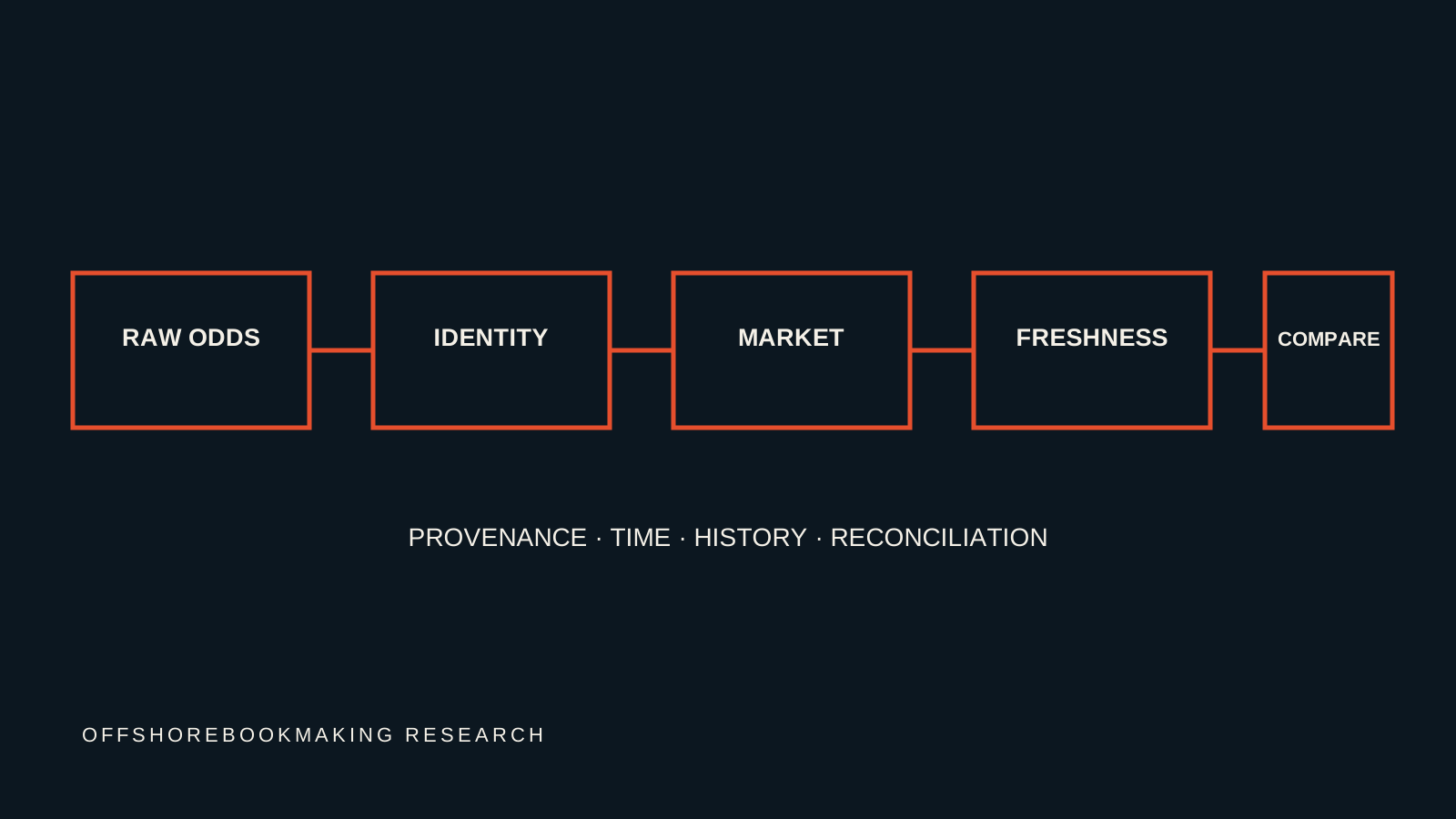
OffshoreBookmaking will evaluate odds pipelines by following the quote from source to comparison. First resolve the canonical event. Then identify period, market family, outcome and line. Preserve raw provider values and normalize price into a consistent numeric representation. Record provenance and distinct timestamps. Apply freshness and availability rules before a quote enters the current comparison set. Keep append-only observations for history while projecting bounded current state for fast reads. Calculate best price or movement only across semantically equivalent records, and retain the evidence used by every derived metric. Finally, reconcile disagreements explicitly. This framework links Data to Technology's API contracts, Operations' exception handling and Providers' feed evaluation. Reliable odds comparison is not primarily a formatting problem; it is an identity, time and evidence problem.