Sportsbook Provider Procurement: From RFP to Contract and Exit
A practical framework for requirements, API validation, pricing, SLAs, security, support, data portability, contract controls and supplier exit.
Provider selection should begin with architecture, not a sales demo
Sportsbook procurement often starts too late in the decision process. A team sees a polished demonstration, receives a feature list and begins comparing commercial proposals before it has defined which responsibilities the supplier will actually own. That reverses the useful order. The operator should first map its target operating model: customer account, wallet, betting engine, trading, sports data, payments, identity, reporting, compliance-sensitive workflows, content and integrations. Only then can it decide which capabilities belong inside the company and which can be supplied externally. A provider that is excellent in one architecture can be a poor fit in another. OffshoreBookmaking therefore evaluates suppliers against the role they must perform in the complete stack, not against the number of features on a brochure. Procurement is an architecture decision with commercial consequences.
The requirements matrix is the control document for procurement
A structured requirements matrix prevents a procurement process from becoming a sequence of impressions. Requirements should be separated into mandatory, desirable and optional capabilities, with each item assigned an owner and a verification method. Functional requirements might cover market management, account states, settlement, reporting or localization. Non-functional requirements should address availability, latency, security, data portability, observability, support and recovery. Regulatory requirements vary by jurisdiction and should be mapped separately rather than hidden inside a generic compliance row. The matrix should also distinguish capabilities available today from roadmap commitments. A provider response of 'supported' is not enough when the requirement is critical; the buyer needs to know whether support is native, configurable, custom-built or dependent on another supplier. This discipline creates a record that can survive staff changes and later contract negotiations.
Integration depth is more important than the number of APIs
A provider can advertise a large API catalogue while still being difficult to integrate. What matters is whether the interfaces expose the objects, states and events the operator actually needs. Buyers should inspect authentication, identifiers, pagination, rate limits, idempotency, webhooks or streaming behavior, error models, versioning and sandbox fidelity. They should also understand which operations are synchronous and which settle asynchronously. Technology #002 explains why canonical identity and reconciliation matter across service boundaries; procurement should test those principles before signing. Sample payloads are useful, but a controlled proof of concept is stronger because it reveals undocumented assumptions. Integration evaluation should include failure conditions: duplicate requests, stale events, delayed callbacks, partial outages and credential rotation. A good integration is not merely one that works during the happy path; it remains understandable when systems disagree.
Data ownership and portability must be explicit before launch
Operators create valuable records through customer activity, wagering, payments, risk decisions and operational history. Contracts and technical designs should state who owns or controls each category, what can be exported, in which format and on what timetable. Portability is especially important for canonical identifiers, customer histories, balances, wagers, settlements, audit records and configuration. A provider may legitimately own proprietary algorithms or platform code while the operator still needs usable exports of its operational data. The distinction should be explicit. Procurement should also ask whether derived data can be retained after termination and whether historical access requires continued fees. Industry #002 describes portability as strategic freedom because switching costs rise when data cannot move cleanly. The cheapest time to negotiate an exit is before the relationship begins, when both parties still have alternatives.
Pricing needs to be modeled against realistic operating volumes
Provider pricing can include setup charges, minimum monthly commitments, per-account fees, transaction charges, data usage, support tiers, revenue share and separate third-party pass-through costs. Comparing headline prices without a volume model can therefore be misleading. Procurement should build scenarios for launch, expected growth and stress cases. Each scenario should calculate fixed and variable charges using the contractual definitions, including minimums and thresholds. Revenue-share pricing needs particular care because the denominator and permitted deductions determine the effective cost. Buyers should identify which costs increase with customers, bets, payment transactions, API calls or markets. They should also model currency and tax treatment where relevant. A commercial proposal becomes useful only when it can be translated into unit economics. The objective is not simply the lowest quoted price, but visibility into how the supplier cost behaves as the operator changes scale.
Service levels should measure outcomes that matter to the sportsbook
An SLA that promises a high monthly uptime percentage can still leave important operational gaps. Buyers should define which service is being measured, how availability is calculated, what exclusions apply and what happens when only part of the platform fails. A sportsbook may need separate expectations for account access, bet placement, pricing feeds, settlement, payments or reporting. Response and restoration targets should distinguish severity levels and business impact. Support coverage must match the operator's trading hours, which for sports betting can extend across nights, weekends and holidays. Service credits can provide accountability but do not repair customer trust or lost activity, so escalation and recovery procedures matter more than the credit alone. Procurement should request historical performance evidence where available and understand how incidents are communicated. Reliability is an operating capability, not a percentage printed in a contract.
Security review should follow the data and authority the supplier receives
Security due diligence should be proportional to what a provider can see or do. A vendor receiving public sports schedules presents a different risk from one that stores identity documents, controls wallet transactions or can change wager states. Buyers should map data classes, privileges, credentials, network access and administrative functions before selecting controls to review. Relevant evidence can include security certifications, penetration testing practices, vulnerability management, access governance, encryption, logging, incident response and business continuity, depending on scope. Certifications can support due diligence but should not replace architecture-specific questions. Procurement should also understand subcontractors and cloud dependencies where they materially affect the service. Regulation #002 explains why supplier relationships can become part of compliance evidence. The practical question is simple: if the supplier is compromised or unavailable, what customer, financial and regulatory consequences can follow?
Operational support should be tested before a crisis
Sales teams are optimized for acquisition; production support determines the long-term relationship. Procurement should identify the actual support model: channels, hours, severity definitions, escalation contacts, engineering access and expected response times. It should also determine who owns routine configuration, data corrections, settlement exceptions and integration troubleshooting. A provider can have strong technology but create operational friction if every change requires a slow ticket process. During evaluation, buyers can test support with realistic technical questions and observe whether answers are precise, documented and consistent. References from existing customers may provide additional context, though operating models differ. The contract should establish escalation paths, but teams also need practical runbooks. When a live event, payment route or critical API fails, the operator should know who is authorized to act and how evidence will be preserved.
Change management determines whether today's integration remains stable
Provider relationships evolve after launch. APIs are versioned, market taxonomies change, infrastructure migrates, security controls tighten and product features are introduced or retired. Procurement should therefore examine how the supplier communicates change. Useful controls include documented release notes, advance notice for breaking changes, test environments, deprecation periods and named emergency procedures. The operator should know whether updates are automatic or require acceptance and whether customizations can block upgrades. Changes that affect regulatory controls or customer money deserve especially strong governance. A mature supplier should be able to explain how it tests compatibility and rolls back failed releases. Technology architecture and provider management meet at this point: stable contracts between systems require stable communication between organizations. A good procurement decision accounts for the provider's change process, not only the current product snapshot.
Exit planning belongs inside the original contract
Every provider relationship ends eventually through replacement, acquisition, product retirement, strategic change or business failure. Exit planning should therefore be designed at the beginning. Buyers need to know how data will be exported, how long access continues, what transition assistance is available and what happens to credentials, customer information, backups and proprietary integrations. Contracts may need termination rights tied to serious service, security or regulatory failures, while commercial termination provisions should be understood separately. Technical teams should document dependencies so the organization can estimate migration work before an emergency. Where a provider controls a critical identifier or workflow, a transition may require reconciliation between old and new systems. Exit readiness does not signal distrust. It reduces operational risk for both parties by defining how responsibilities unwind when the relationship changes.
A scorecard should expose tradeoffs instead of hiding them in one number
Provider evaluation benefits from scoring, but a single total can create false precision. A supplier that scores highly overall may still fail one mandatory requirement. OffshoreBookmaking's preferred research structure separates gates from weighted comparisons. First, fail closed on requirements that cannot be compromised: required functionality, applicable regulatory capability, security boundaries or essential portability. Then compare viable providers across integration, reliability, support, commercial model, product depth, operational control and strategic fit. Weighting should reflect the operator's actual architecture rather than a universal ranking. Evidence should accompany each score so another reviewer can reproduce the reasoning. This approach also makes disagreement useful: teams can debate the importance of a criterion without pretending that every dimension is objectively equivalent. The purpose of a scorecard is disciplined comparison, not an artificial declaration that one provider is universally best.
A practical procurement framework for sportsbook providers
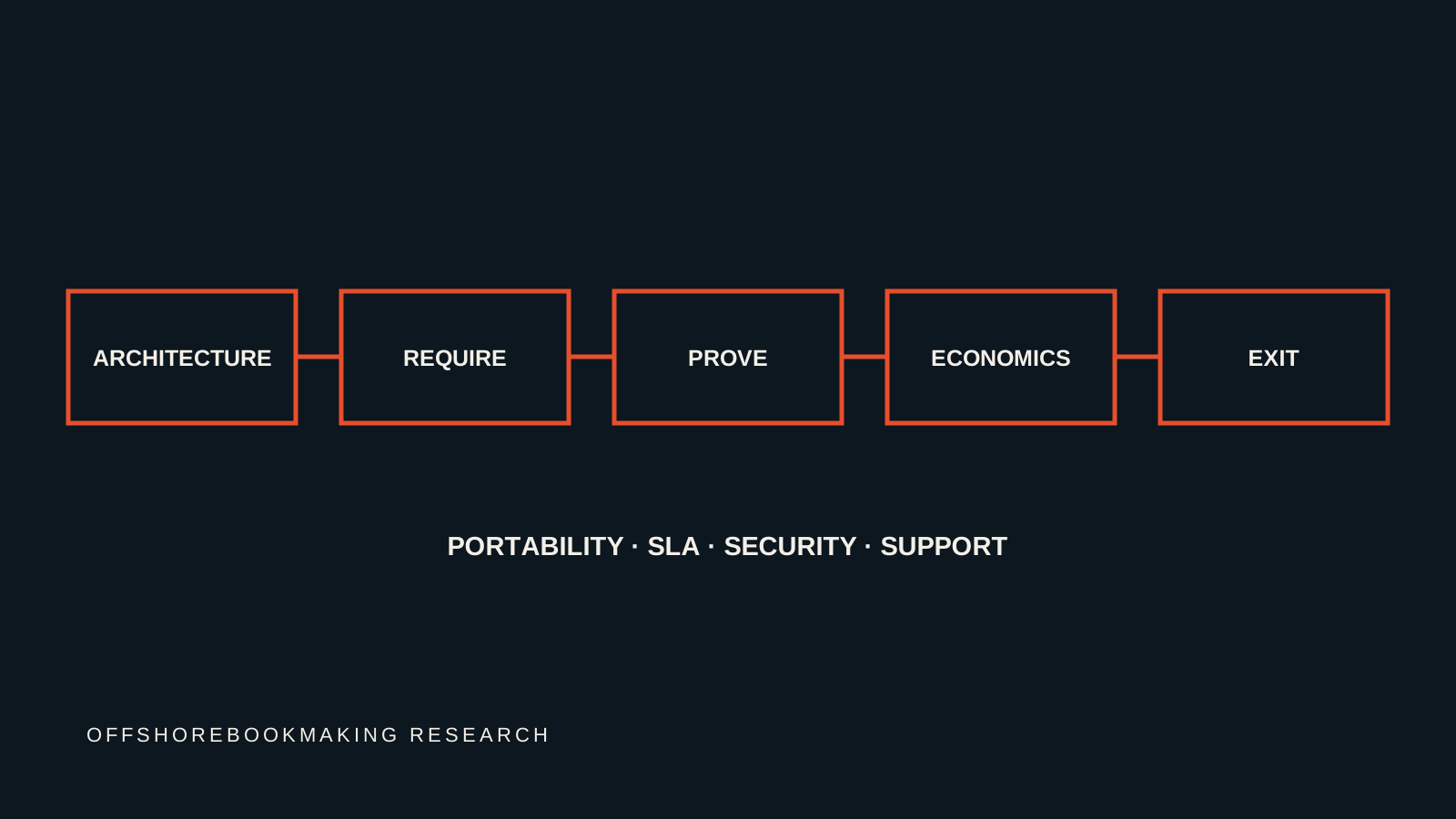
A controlled procurement process can be summarized as architecture, requirements, evidence, economics and exit. Define the operating model and supplier boundary first. Build a requirements matrix with mandatory gates and verification methods. Inspect APIs and run proof-of-concept tests against realistic workflows and failures. Establish data ownership and portability before production data exists. Model pricing at multiple volumes rather than comparing headline rates. Review SLAs, support, security, subcontractors and change management in proportion to the service's criticality. Translate regulatory dependencies into explicit responsibilities and evidence. Negotiate transition and termination mechanics while leverage is balanced. Finally, preserve the evaluation record so future teams understand why the provider was selected. Combined with Providers #001, this gives OffshoreBookmaking a repeatable path from initial due diligence to a defensible procurement decision without reducing complex supplier choices to marketing claims.