Sportsbook API Architecture: Building Reliable Integrations
How canonical identity, idempotency, streaming, versioning, observability and reconciliation make sportsbook integrations resilient.
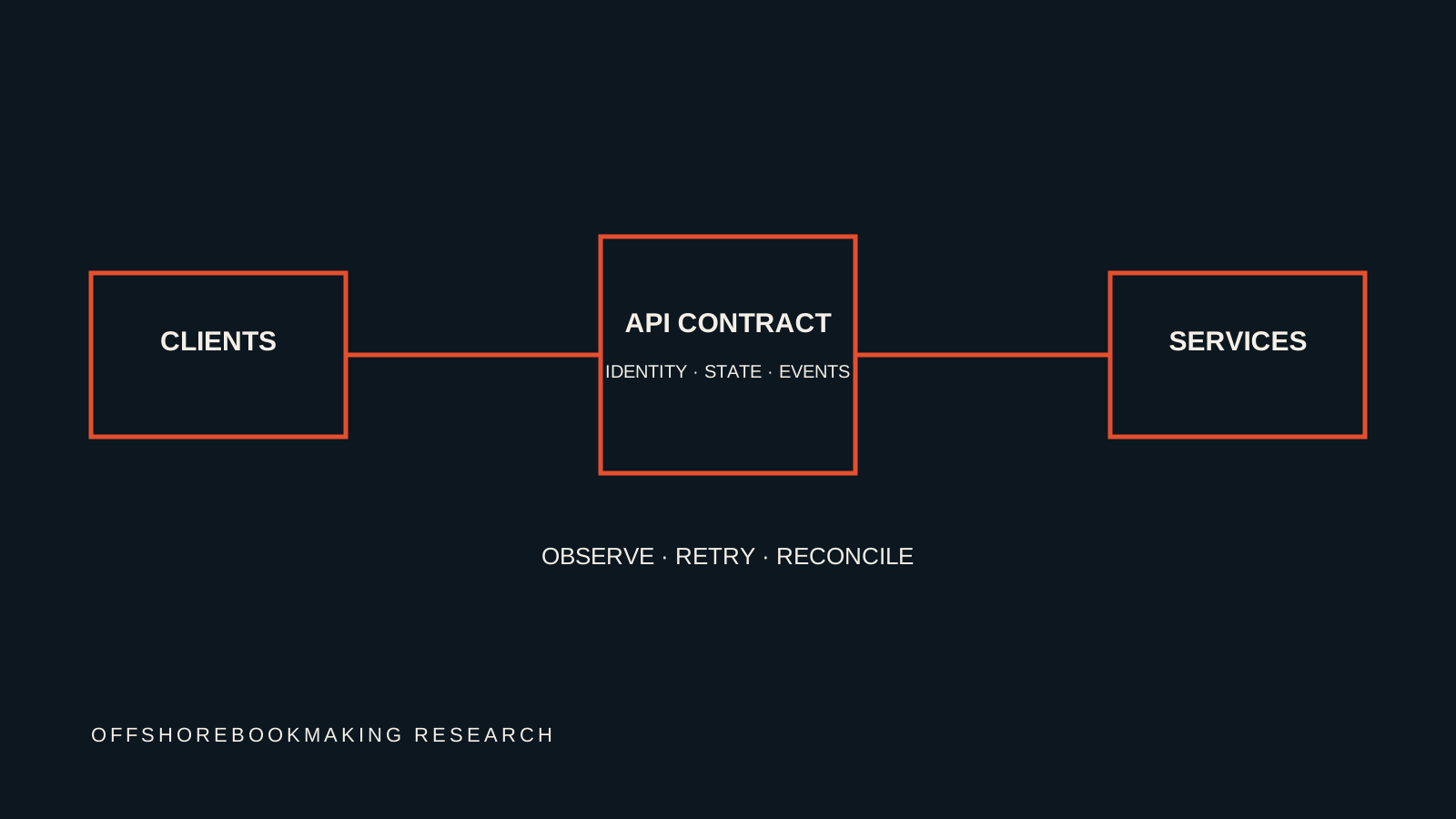
A sportsbook API is a contract between systems
Modern sportsbook stacks are rarely one application. Account services, wallets, trading engines, sports data, payments, identity systems, CRM and front ends exchange information continuously. APIs define the contracts between those components. A useful contract specifies not only an endpoint and payload, but identity, state transitions, validation, errors, authentication, timestamps and compatibility expectations. When those rules remain implicit, integrations become dependent on assumptions hidden inside individual applications. OffshoreBookmaking treats API design as operating architecture because failures at a boundary can affect wagers, balances, market state and customer access. The central question is therefore not whether a sportsbook has an API. It is whether the API exposes a stable, observable and recoverable contract that lets independently changing systems continue to agree about the same business objects.
Canonical identity must survive every integration boundary
An event can arrive from one data provider with one identifier, from a trading service with another and from an internal platform with a third. The same problem exists for customers, markets, wagers, transactions and suppliers. A durable architecture creates canonical internal identities and stores provider mappings explicitly instead of treating an external identifier as permanent truth. This does not mean discarding source IDs; they remain essential provenance. It means the operator owns the relationship between its business object and each external representation. Canonical identity reduces the blast radius of provider replacement and makes reconciliation possible when sources disagree. The Data desk applies this principle to sports feeds, but the same design belongs at every API boundary. Without it, a seemingly simple vendor migration can become a database-wide identity reconstruction project.
REST, webhooks and streaming solve different timing problems
Sportsbook integrations often combine request-response APIs, webhooks and persistent streams. REST-style requests are useful when a consumer knows what resource it needs and can tolerate requesting current state. Webhooks let a provider push discrete changes without constant polling. Streaming connections are valuable when many rapidly changing observations must arrive with low latency, as with live prices or event state. None of these patterns is universally superior. The correct choice depends on update frequency, ordering requirements, recovery behavior and the cost of missing an update. Mature architectures frequently use more than one pattern: a stream for speed, a snapshot endpoint for recovery and a webhook for workflow events. The important requirement is that consumers can determine current truth after interruption rather than assuming every message was received exactly once.
Idempotency protects money and state from retries
Networks fail in ambiguous ways. A client can send a deposit, wager or settlement request and lose the response before learning whether the server completed it. Retrying blindly can duplicate a financial action. Idempotency gives repeated requests a stable identity so the receiving service can recognize that an operation has already been accepted. The exact implementation varies, but the business principle is consistent: retrying the same intended action should not accidentally create a second action. This is especially important around wallet transactions, wager placement, payouts and external payment calls. Idempotency also needs retention and scope rules so keys cannot collide indefinitely. An API that advertises retries without documenting duplicate protection leaves an important operational question unanswered. Reliable integrations design retry behavior together with transaction semantics rather than adding retries after failures appear.
Event ordering cannot be assumed across distributed systems
A sportsbook can receive related updates through different queues, regions or providers. Messages may arrive late, be duplicated or appear out of order. If consumers simply apply every message in arrival order, an older state can overwrite a newer one. Robust systems therefore carry version information, source timestamps, sequence numbers or another mechanism that lets a consumer reason about ordering. The correct mechanism depends on the domain. A market-price observation may be append-only, while a customer account state may require optimistic concurrency or a version check. Effective time should also be distinguished from observed and recorded time. This mirrors the Data desk's temporal model. Distributed architecture becomes easier to audit when systems preserve what they knew, when they knew it and which update caused the resulting state.
Rate limits are part of capacity planning
API rate limits are not merely developer inconvenience. They determine how quickly a sportsbook can synchronize catalogues, recover after downtime and support traffic spikes. Providers may limit requests per second, minute, hour or day, and some count returned entities or data volume in addition to calls. Integration design should model those limits against normal operation and worst-case recovery. A service that works during development with ten events may fail when thousands of events need refresh simultaneously. Caching, batching, pagination and backoff can reduce pressure, but they need explicit freshness rules. Operators should also monitor quota consumption before exhaustion and understand whether limits differ by endpoint or commercial tier. Capacity planning is therefore both technical and commercial: additional throughput may require a different contract long before it requires new application servers.
Authentication should identify both the caller and its authority
API keys are common because they are simple, but production security requires more than possessing a secret string. Systems should know which application or service is calling, what actions it is authorized to perform, how credentials are rotated and what happens when one credential is compromised. Least-privilege scopes can reduce the impact of leakage by separating read access from write or administrative capabilities. Short-lived credentials and signed requests can be appropriate in some architectures, while network controls add another layer. Secrets should not be embedded in front-end code or logs. Provider due diligence should also ask whether credentials can be created and revoked independently for environments and integrations. Good authentication architecture supports incident response: the operator can disable one compromised path without taking every connected system offline.
Versioning is a promise about controlled change
Every useful API changes eventually. Fields are added, definitions evolve and legacy behavior must be retired. Versioning provides a framework for those changes, but a version number alone is not enough. Providers should document backward-compatibility expectations, deprecation notices, migration windows and changelogs. Consumers should avoid depending on undocumented behavior and should validate payloads defensively when optional fields appear. Contract tests can detect breaking changes before they reach production. For internal APIs, the same discipline prevents one team from silently changing a payload used by another. A sportsbook with many suppliers benefits from maintaining an integration inventory that records API versions, owners and deprecation dates. Technical debt becomes operational risk when an obsolete integration cannot be upgraded without interrupting betting or payments.
Observability must cross service boundaries
When a customer reports that a wager failed, engineers may need to trace the request across front end, gateway, account service, wallet, trading engine and external supplier. Separate logs are insufficient if they cannot be correlated. A consistent request or trace identifier lets teams connect activity across services without using personal data as the primary search key. Metrics should describe latency, error rates, queue depth, stale data and business outcomes such as rejected wager placement. Structured logs should capture enough context to explain a failure while avoiding unnecessary sensitive information. Alerting should distinguish local application errors from upstream degradation. Observability is therefore part of the API contract: every boundary should make it possible to determine what was requested, what happened and which downstream dependency affected the result.
Failure isolation prevents one supplier from becoming a site-wide outage
External services will eventually slow down or fail. Architecture should decide in advance which features can degrade independently. A delayed statistics feed should not necessarily disable account login; a CRM outage should not block wager settlement. Timeouts, circuit breakers, queues and cached state can prevent waiting requests from exhausting application resources. The correct fallback depends on the function: stale odds may need to be hidden, while a noncritical profile image can continue from cache. Fail-closed and fail-open decisions must be explicit, particularly where money, security or regulatory controls are involved. Operations should know when a circuit has opened and what manual action is permitted. Designing isolation around business capabilities keeps a local dependency failure from automatically becoming a full sportsbook outage.
Reconciliation is the recovery layer after asynchronous processing
Real-time processing optimizes for speed, but financial and betting systems also need a slower process that proves records agree. Reconciliation compares authoritative records across boundaries: payment processor against wallet ledger, trading settlement against wager state, provider event results against internal outcomes. Differences should become explicit exceptions rather than silent overwrites. This is especially important when messages can be delayed or a provider outage creates a backlog. A good reconciliation job is repeatable, records what it compared and preserves the evidence behind corrections. It should not depend on manually editing production data until totals happen to match. The Operations and Data desks both rely on this principle. APIs move information; reconciliation establishes that the movement ultimately produced a consistent business state.
A practical integration standard for sportsbook technology
OffshoreBookmaking will evaluate sportsbook integrations through a common set of questions: What is the canonical object? Which system is authoritative for each field? How is a request authenticated? Can writes be retried safely? How are duplicates and ordering handled? What timestamps are preserved? What are the rate limits and recovery path? How are breaking changes announced? Can activity be traced across boundaries? What happens when the dependency is unavailable? Finally, how is state reconciled afterward? This framework turns an API review into an operating-system review rather than a checklist of endpoints. It also creates direct links to Data, Operations and Providers: identity and provenance belong to Data, recovery and responsibility belong to Operations, and external service guarantees belong to provider due diligence. A reliable sportsbook stack emerges when those disciplines agree at every boundary.